Voices: Believers in Christ have an edge

We Christians living today possess an advantage even the first disciples of Christ did not have as they followed our Lord through Roman-occupied Israel.

It is also an advantage others living in our world today do not have, those who are unbelievers.

We believers have an edge.

We have an edge in better understanding, not only what is going on in this world of ours, but also in understanding and interpreting the Bible.

What is this edge?

During their last meal together, Jesus instructed his disciples to ask his father to send us an edge.

“If you love me, keep my commands. And I will ask the Father, and he will give you another advocate to help you and be with you forever—the Spirit of truth. The world cannot accept him because it neither sees him nor knows him. But you know him, for he lives with you and will be in you” (John 14:15-17).

The Holy Spirit is the believer’s edge.

The Holy Spirit’s presence in our lives

His ministry has changed from ancient times.

In the Old Testament, his work was largely task-driven. In those days, the Holy Spirit “came upon” individuals. He was with Moses when he parted the Red Sea. He was with David when he slew the giant Goliath.

Then, the Holy Spirit equipped men and women with the power they needed to accomplish specific tasks.

Now, the Holy Spirit resides within us to guide us throughout our lifetimes.

It was the Old Testament prophet, Ezekiel, who first foresaw the day when God would reside within believers.

Ezekiel quoted God saying:

“I will give you a new heart and put a new spirit in you; I will remove from you your heart of stone and give you a heart of flesh. And I will put my Spirit in you and move you to follow my decrees and be careful to keep my laws (Ezekiel 36:26-27).

That prophecy was fulfilled about 550 years later on the day we call Pentecost. It was the 50th day after Jesus arose from the grave.

When the day of Pentecost came, they were all together in one place. Suddenly a sound like the blowing of a violent wind came from heaven and filled the whole house where they were sitting.

They saw what seemed to be tongues of fire that separated and came to rest on each of them. All of them were filled with the Holy Spirit and began to speak in other tongues as the Spirit enabled them (Acts 2:1-4).

Since that day, every new believer receives the Holy Spirit. God takes up residence within us and equips us to accomplish his will.

The Holy Spirit’s role in our lives

Jesus called him “another advocate to help you and be with you forever—the Spirit of truth” (John 14:16).

“Advocate” is derived from a Greek word that means to “come alongside.” God’s Spirit, in a sense, “comes alongside” us Christians as a helper, a teacher, a guide and an encourager.

If the Holy Spirit is “another” advocate, then who is our primary advocate?

John identified him also, in his first epistle.

My dear children, I write this to you so that you will not sin. But if anybody does sin, we have an advocate with the Father—Jesus Christ, the Righteous One (1 John 2:1).

Jesus Christ is our Advocate with our Father in heaven. The Holy Spirit is our Advocate within us, here on earth.

Jesus told his disciples:

“These things I have spoken to you while abiding with you. But the Helper, the Holy Spirit, whom the Father will send in my name, he will teach you all things, and bring to your remembrance all that I said to you” (John 14:25-26).

Our “Helper, the Holy Spirit,” has two basic jobs.

One is to teach us “all things.” That’s a broad responsibility. The Holy Spirit teaches us primarily by revealing truth as we study the Bible.

The second is to “remind us” of everything Jesus taught us. He does so moment by moment as we go about living our lives.

Like Elijah who heard the Lord speak, not in a powerful wind that tore mountains apart, nor in an earthquake, nor in the fire that came after. Elijah heard the Lord in a gentle whisper—a “still small voice” that gave guidance and direction (1 Kings 19).

That “gentle nudge” a Christian often senses to “do the righteous thing” is the Holy Spirit speaking to us in a “still, small voice.”

The Holy Spirit is also our source of peace in troubled times. Jesus put it this way:

“Peace I leave with you; my peace I give you. I do not give to you as the world gives. Do not let your hearts be troubled and do not be afraid” (John 14:27).

The “peace” Jesus gave to us is the Holy Spirit. Thanks to him, we have no need to fear.

Thanks to the Holy Spirit, we understand more clearly God’s word.

Thanks to the Holy Spirit, we may live our lives better in ways that honor and glorify the Lord.

The Holy Spirit truly is the believer’s edge.

Rich Mussler is a member of First Baptist Church in Lewisville. He teaches the Bible and produces a weekly YouTube video. The views expressed are those of the author. Sunday, May 28, is Pentecost.


Voices: Baptists, confessions, creeds and clarity

In a recent editorial, Baptist Standard Editor Eric Black discussed the current debate in the Southern Baptist Convention regarding female pastors and the nature of “confessionalism.” Black called attention to some important remarks from SBC President Bart Barber.

Barber has pointed out cooperating SBC churches must have “a faith and practice which closely identifies with the Convention’s adopted statement of faith,” per the SBC constitution. But he further points out, “Nobody knows what ‘closely identified with’ means in terms of actually applying it to the case of individual churches.”

In short, while the 2000 Baptist Faith and Message is the official statement of faith for the SBC, the convention is “vague on purpose” (Barber’s words) regarding the precise nature of agreement with the 2000 Baptist Faith and Message required for membership in the SBC.

Barber is not the only prominent Southern Baptist to make this point. I agree with him and others that this problem plays a major role in the current conflict within the SBC. But this problem is not isolated to the SBC, and there is an important lesson all Baptists can learn from this situation.

The “creedalism” boogeyman

In moderate, progressive and even some conservative Baptist circles, “creedalism” is a dirty word. “No creed but the Bible!” is a popular slogan among many “anti-creedal” Baptists and many other evangelical Protestants.

There is no settled, formal definition of “creedalism,” however. Rather, the term is meant to evoke the mental image of a controlling, doctrinaire church hierarchy using coercive means to force theological uniformity on local churches and other Christians. Naturally, Baptists strongly oppose such a concept.

On the other hand, there are more nuanced conceptions of “creedalism.” Some understand “creedalism” to be, in essence, requiring complete agreement with a specific statement of faith for membership in a local church, association of churches or other group.

Many Baptists still oppose this more nuanced version of “creedalism,” however. When the Baptist General Convention of Texas removed multiple churches several years ago after those churches embraced an “open and affirming” stance toward LGBTQ people, many moderates and progressives decried the BGCT’s action as “creedalism” and a denial of local church autonomy.

In Baptist life, any time a church or association makes agreement with a particular doctrinal stance a “test of fellowship,” someone inevitably will cry, “Creedalism!”

“Creedalism” is unavoidable

I would argue, however, that some form of “creedalism” is a necessary fact of life for Christian churches and associations of churches—Baptists included. Every association, every local church and even every individual Christian is a “creedalist” on some level.

What do I mean? In Christian life, some level of theological agreement is necessary for peaceful fellowship and harmonious cooperation. A local church cannot and will not be able to function if members can believe whatever they want. An association of churches will implode if various member churches hold diametrically opposed doctrinal stances.

In his book The Creedal Imperative, Presbyterian church historian Carl Trueman points out:

“Christians are not divided between those who have creeds and confessions and those who do not … they are divided between those who have public creeds and confessions … subject to public scrutiny, evaluation, and critique, and those who have private creeds and confessions … not open to public scrutiny, not susceptible to evaluation and, crucially and ironically, not … subject to testing by Scripture to see whether they are true” (16).

Every association, every church and every Christian has a “functional creed.” Whether you label it a “creed” or a “confession,” every Christian organization and Christian person has a standard of faith and practice that serves as a “test of fellowship.” Even the most liberal congregation will refuse membership to those who embrace beliefs or practices the congregation finds abhorrent and intolerable.

As Trueman argues, even “anti-creedal” Christians have functional creeds. Many have pointed out even “No creed but the Bible!” is technically a creed. However, these functional creeds often are not written down and are not subject to public knowledge or scrutiny. And this necessarily breeds the kind of conflict we are seeing in the SBC.

Lessons for Baptists

I hope and pray the SBC takes concrete steps to clarify what the phrase “a faith and practice which closely identifies with” means. While that clarification will not solve all the convention’s doctrinal disputes, it will establish the stakes of those debates.

If the SBC is not clear on what “closely identifies with” means when it comes to the 2000 Baptist Faith and Message, then it doesn’t really matter what it says about female pastors. Regardless of where you stand on the question of female pastors, you should want clarity and consistency regarding the doctrinal standards required for membership in the SBC.

The Southern Baptist Convention has a creed. The Baptist General Convention of Texas has a creed. Every Baptist church and association of Baptist churches has a creed. If that creed is not clearly written down for the public and consistently enforced, then the creed becomes nothing more than the whims of the powerbrokers in a given church or association.

I firmly believe the Bible is the final authority for Christian faith and practice. Scripture alone is inspired, infallible and inerrant. Every human confession and creed is subordinate to God’s word. No church body has the right to force a confession or creed on others. But churches, associations and individual Christians all need to be able to summarize what we believe Scripture teaches on key points.

Some of these summaries of faith—confessions and creeds—will function inevitably as “tests of fellowship” in Christian life. This is unavoidable. And, as I have written elsewhere, “Baptist groups [have the right] to define themselves by particular beliefs and to exclude from membership those who do not share those beliefs.”

Therefore, it is better for such confessions and creeds to be written down clearly than to be hidden behind the vague language of “a faith and practice that closely identifies with.”

Joshua Sharp is the pastor of Trinity Baptist Church in Orange, and a graduate of Southwest Baptist University in Bolivar, Mo., and Baylor University’s Truett Theological Seminary in Waco. The views expressed are those of the author.


Voices: Beth Moore inspires me to be honest about the struggle

Women’s ministry has never held a special place in my heart. Probably because, in some of my experiences, it has been a lot of superficial messages like: “You are beautiful. Here’s something to make you feel good about yourself.” I’ve never been interested in that.

When I was growing up, Beth Moore and women’s ministry were pretty much synonymous. I thought that until I attended a conference of hers as a young adult and experienced the power of God alongside thousands of other women.

I felt called to ministry 15 years ago, and I began to watch Beth more closely during my college years. Then I felt called to preach and watched her stand up and do unapologetically what God had called her to do.

I watched her walk away from the Southern Baptist Convention and continue to advocate for those who were oppressed and marginalized. I watched her hold tightly to her convictions even when it wasn’t popular and when her own people turned on her.

I recently read Beth’s memoir All My Knotted-Up Life. I write like I know Beth personally. I don’t. But as I read, it felt like we were sitting in a coffee shop as she told me her story. I couldn’t put it down, and I couldn’t help my tears.

Her heart and soul were poured into the pages of that book—the shiny parts, the hard parts and all the parts in between. It was all woven together in a tapestry of God’s goodness and grace. It was real life. No sugar coating. No pretending it was something it wasn’t. That resonated deeply within me.

Tired of pretending

I had a similar experience at a women in ministry conference in 2021. A friend of mine convinced me to go with her and I went begrudgingly. As we turned into the parking lot, I thought to myself: “I swear, if they tell me I’m beautiful and hand me a cup of tea, I’m out.”

Instead, we walked into Alcoholics Anonymous-style introductions and hit the ground running. In the first session, Angela Gorrell shared about the deep trauma and loss in her life. I knew immediately I was in a place with my kind of people.

By the end of the weekend, I had words for what I had longed to believe as truth: When believers prioritize honesty and vulnerability with one another, we are emulating the life of Christ and discipleship becomes authentic.

I recently was sitting with a friend at lunch. We were swapping stories and sharing the complexities of family life, the struggle of living with anxiety as a believer who also believes in the work of psychiatry and medicine, and trying to figure out how to teach our children that none of us have anything figured out.

She said something like: “I’m done. I’m done with people pretending they have it all figured out. It’s a lie. None of us do. We all are doing the best we can and should be trying to help each other along.”

She’s right. We live life pretending everything is nice, neat and follows all the rules.

But can I tell you a secret? The rules are made up, and the game doesn’t exist. Our only chance at survival is the precious blood of Jesus. Our only chance at making the most of our life here on earth is salvation and authentic discipleship with other believers.

Honest about the struggle

How do we do this? We start with honesty. We are honest with ourselves, our Savior, and our brothers and sisters in Christ. We live real life together. We share real life together. Most importantly, we recognize none of us have it all together.

Though this type of life and ministry is counterintuitive, it is an authentic picture of the gospel of Jesus Christ. It’s an authentic representation of God’s grace in our lives and the grace we can extend because we are made new in Christ.

My brothers and sisters, we are made for so much more than “having it all together.” I assure you, I don’t and I haven’t ever had it all together. But I also haven’t been all that good at admitting it in the past.

So, here’s the honesty for today: We’re all just making it—you, me, your neighbor, your pastor, the person you can’t stand who is wreaking havoc on your life. We’re all just trying to make it while being good stewards of what God has set before us and saying “yes” to the things whispered in the depths of our soul.

Abby Manes is the children’s and family minister at First Baptist Church in Muleshoe. She is the proud foster mom of three and spends her time chasing kids, investing in her church and the surrounding community, and drinking good coffee. The views expressed are those of the author.


Voices: Sabbath: You have permission to rest

Some things we never forget—the first day of school, getting married, having your first child or getting baptized. Many people can recall these events like they were yesterday.

Sabbath is a day many people do forget, however. Why do we forget about the Lord’s fourth commandment?

I never will forget the day I read an article and truly rested for what felt like the first time. My teacher instructed us to read the article “Doing Nothing is Something” and then go outside for 20 minutes. We had to leave everything inside—our phones, laptops, pens, paper, everything—to embrace the quiet.

When we came back inside, most of my classmates seemed anxious, sleepy or annoyed. I, however, was the most rested I had felt in a long time. Unfortunately, I had no idea what to do with the experience. Should I do this again? Was taking 20 minutes to rest even allowed? What if this was the only time I ever would feel this way?

A few years after reading this article, I was surprised and convicted when I listened to a sermon by guest preacher A.J. Swoboda at Bridgetown Church in Portland and realized not once had I remembered the Lord’s fourth commandment.

I knew the fourth commandment was about having a Sabbath, but I never had realized the profound implications of the Lord commanding us not to participate in Sabbath, but to remember the Sabbath.

Understanding Sabbath

The irony of forgetting the Sabbath lies at the heart of our obsessive need never to stop. Being busy is for us about making memories and showing others our worth, but what happens when we forget where our true worth lies? What happens when value is determined by society rather than being made in the image of God?

God rested on the seventh day (Genesis 2:1-3). Jesus rested all the time. In fact, we most often read of Jesus resting when the world was turning upside down for everyone around him (Mark 6:31; Matthew 15:21-28; 16:13-18). If God rested and commanded us to rest, and if Jesus also rested, why is resting so hard for us?

In today’s world, busyness can be a positive predictor of productiveness or a warning sign of deeper issues in one’s life. Either way, both pathways lead away from rest, which is a basic necessity in Maslow’s “Hierarchy of Needs” and a directive from YHWH (Exodus 20:8-10a, 11b).

The disconnect between God’s command and our struggle to keep it might be due to a misunderstanding. The definition of rest often seems to be confused with the concept of being idle. But rest includes activity such as thinking introspectively and honoring and celebrating the goodness of God.

A person, a family or even a community does not rest for the sake of simply “stopping,” but rather to take a moment—or even a full day—to remember why we are alive, why we work and to celebrate being children of YHWH.

Ways to practice rest

The following are a few ideas for beginning the journey of rest.

1. Put away electronic distractions for at least 30 minutes a day. Seek to hear the Father’s still, quiet voice, or have an intentional conversation with a loved one beginning with prayer and thanksgiving. Where two or more are gathered, there our God will be also (Matthew 18:20).

2. Go for a walk, lay in the grass, or sit on a bench in silence with no distractions for 10 minutes. The voice of God is still and quiet, and he seeks time with you alone, just like he did with Jesus (Luke 5:16).

3. Practice awareness with your senses. Here are three ways to do that.

(a) Put dry rice in a bowl. For five minutes, put your hand in the bowl and feel the rice. Notice your hand, the rice touching your hand, your muscles moving. This practice is for reorienting yourself to the present rather than everything that has happened and everything that will happen. There is enough happening today; there is no need to worry about tomorrow (Matthew 6:24).

(b) Take 10 minutes to eat or drink something you enjoy. Notice the distinct tastes, the feeling you experience both in your mouth and in your heart. As you savor, have a heart of thankfulness, believing in the privilege we have to enjoy our favorite things in life and a Father who gives good gifts to his children (Matthew 7:11).

(c) Set a timer for the time you can spare. Put a song on repeat that lifts your spirit. Whether you sing or listen, notice the rhythm of the song, the beats that carry the music from start to finish, the melody as a unique creation. Feel the environment around you and rest in the goodness of music (Isaiah 42:10).

4. Evaluate: What is God saying to you through this? Reflect on how much you rest and why you do not rest. Would the world continue if you took a break? If the world would stop, why? If the world doesn’t stop, are you still OK?

Child-of-the-One-Who-Knows-You, you have permission to rest. You have permission to heal. You have permission to see yourself the way our Father in heaven sees you—loved, seen and forgiven. May you rest in this knowledge. May you remember the Sabbath. Amen.

CORRECTION: The number of the Sabbath commandment was corrected to “fourth,” and the reference to A.J. Swoboda was updated to include he was the guest preacher (May 11, 2023).

Kayelee Arensman is a graduate of Baylor University’s Diana R. Garland School of Social Work and is pursuing a Master of Divinity at Baylor’s Truett Theological Seminary. She is a licensed master social worker and a member of Highland Baptist Church in Waco. The views expressed are those of the author.


Voices: Three ways to support women ministers whole-heartedly

As the Baptist world questions the fact, yet again, of women being called by God to lead and teach people, I am saddened and angered we have come to the point of making lists of women ministers and sharing their personal information.

At the same time, I am happy to see people demonstrate their support. Voices backed by Scripture definitely have been raised and are showing the world Christ chose women to preach the good news of his resurrection.

As I celebrate these voices, I also keep telling myself there’s more we can do to demonstrate fully that we affirm and value our female ministers.

I am a female minister with the privilege of serving as an associate pastor at a great congregation that has submerged itself in the process of discerning God’s calling. As any church that never has had a female minister, we’ve had to explore new territory in recent months.

While examining what it means for the church to provide support and affirm me as a pastor, woman and mother, I realized there is much more to affirming women in ministry than simply hiring a female pastor. There is much more we could do but don’t, because we haven’t had to think about it before.

Women always have been called, but society hasn’t always allowed us to follow that calling. As we see a rise in women affirming their calling and ignoring the limitations society has placed on us, it is important that congregations start thinking about the things being overlooked.

It is great when a congregation hires a woman pastor. We also must examine our policies and ideologies to make sure women are affirmed through all of our actions. We must be proactive instead of reactive.

I have encountered a few things in the past year I believe are extremely important and would be helpful as we ask ourselves if we really are supporting our female ministers.

1. Write a maternity leave policy before it’s needed.

As I grew close to giving birth to my second child, my pastor, church leaders and I started exploring what maternity leave would look like. As I did my research, I was disappointed to find paid maternity leave basically is nonexistent in a lot of congregations. If it does exist, it typically is focused on protecting the church rather than taking care of the minister.

Bringing a child into the world is beautiful; however, it also brings a lot of trauma to the body, emotions and mental state. Affirming our female ministers means taking time to write policies that give them the time they need to recover and spend time with their growing family.

2. Be flexible.

Women wear a lot of hats. We are pastors, mothers, wives, keepers of the schedule and more, which means we must be flexible.

Historically, this has been seen as a weakness of having a female on staff. Let me challenge that: Wearing a lot of hats and still doing a great job within all roles is nothing but a strength and asset.

Allowing for flexibility in working hours and office hours will support your female ministers significantly. Is it necessary to be in the office from 8 a.m. to 5 p.m.? Or can ministers do some work from home where they also can watch a sick child?

Do we really need ministers in the church office all day, or can women ministers work a few hours from home, providing the ability to breastfeed their babies? Giving women ministers flexibility—should they want it—goes a long way and can lead to healthier pastors.

3. Be better and go the extra mile.

I encourage churches not to limit themselves as they formulate personnel policies. Ministers already have a hard time with self-care because of the demands of the job. Keep this in mind when creating policies such as maternity leave.

God gives grace in our lives, so let’s apply that grace to our congregational policies. Let’s not limit our grace to what corporate policies state or what the law requires. Are we not called to do more than what the world does? We are called to extend God’s grace in everything we do.

Though my focus here is on how we can support our female ministers fully, these three ideas can be applied to male ministers also. Having paternity leave is also incredibly important.

My thoughts and opinions are based solely on the care—or lack thereof—I’ve seen extended to female ministers.

I am a blessed minister. I get to follow Christ’s calling in my life in a congregation that affirms me. Yes, we’ve entered new territory, but we are doing it all with the guidance of the Holy Spirit, keeping in mind what Christ would call us to do if he were with us in the flesh.

It’s time. We must go the extra mile to live lives that not only speak of our affirmation and support towards female ministers, but also lives that put those words into action.

Cintia Aguilar is the associate pastor at Primera Iglesia Bautista de Waco and a workshop facilitator with Fellowship Southwest. Cintia is a graduate of Baylor University’s Diana Garland School of Social Work and its Truett Theological Seminary with a joint master’s degree in divinity and social work.


Voices: Why Texas Baptists oppose legalized gambling

One of the most surprising reports I heard from legislators during the 2023 Texas Baptists Advocacy Day concerned gambling. They said it was primarily Texas Baptists who are keeping sports betting, casinos and online lottery sales out of Texas.

It is truly a David vs. Goliath battle as Texas Baptists are up against a team of lobbyists and special interest groups who want gambling legalized.

So why are Texas Baptists against legalized gambling? Isn’t it a harmless source of entertainment that will generate more tax dollars for the state’s budget?

The No. 1 reason why we are opposed to gambling is because gambling takes advantage of the poorest and most vulnerable among us.

In Genesis 4, Cain was asked by God about the whereabouts of his brother Abel. Cain had murdered Abel, but he replied to God, “Am I my brother’s keeper?” The answer is, “Yes, you are!”

We are expected to look after one another and to love, care for and protect each other. Our Texas legislators are charged with protecting the weakest and most vulnerable among us. But if they vote to legalize gambling, it is proven statistically to harm the poor and young adults the most.

Gambling harms

Before joining the staff of the Baptist General Convention of Texas, I was pastor of Shiloh Terrace Baptist Church in East Dallas. The church is located in a lower- to middle-income neighborhood.

I’ll never forget one church member requesting benevolence assistance. She told me: “I have to hide the grocery money from my husband. He’ll waste it on lottery tickets and sometimes spend up to $100 a month on it. He’s sick.”

Habitual gambling is a mental illness. It’s a siren song appealing to our base desire to “get rich quick.”

Make no mistake, the gambling industry is funded by those who can least afford to lose their money and who are most likely to become addicted.

Texas already struggles to provide mental health services to our residents. Legalized gambling would only compound the problem and create a new mental health crisis.

Almost 1 million young people between the ages of 14 and 21 in the United States are already gambling addicts. Some estimate up to 75 percent of college students have gambled in the past year.

In many instances, online sports wagering is worse for families than casino gambling. It’s accessible from their smartphones in the privacy of their homes instead of publicly.

An entire generation of addicted gamblers, often young males who like sports, are losing their livelihoods. They often leverage credit or borrow money from their small business if necessary to pay for their gambling addiction.

Gambling will lead to higher rates of crime, domestic violence, bankruptcies, divorce, depression and suicide.

Advocating against legalized gambling

I want to encourage you to contact your state representative, state senator and Gov. Abbott to let them know you are opposed to all forms of gambling. You can find your legislators here.

We are advocating for or against many other important issues as well. You can find the latest public policy update at the Christian Life Commission website.

Baptists are a politically diverse body of believers. Let’s take seriously the call to be salt and light, and let’s stand together to protect and preserve the culture around us until all people come to know Jesus.

Craig Christina is the associate executive director and acting executive director of Texas Baptists. This article is adapted from his Texas Baptists Weekly Update email and published by permission.


Voices: Why and how to advocate at the Texas Capitol

The history and culture of Texas has captivated people across the world for a long time. The Texas State Capitol embodies much of this.

The Capitol is the common property and birthright of all Texans. The site of the Capitol—with its historic treasures and numerous masterworks of literature and art, as well as the Lone Star State’s stature—demands attention and admiration.

Rather than coming to take it, one should come visit the Capitol, for it is the embodiment of Texas history and the place where public officials labor to meet the problems of state government.

Our Advocacy Day

Participating in Texas Baptists’ Christian Life Commission Advocacy Day is one of the best opportunities to make sure your presence and voice is recognized and heard.

A personal visit also can have more of an impact than an email, writing a letter or making a phone call to your representative. The solution to addressing an issue could lie in your personal visit. This is why we participated in Advocacy Day, and so should you.

The key to how you should visit is respect. Being polite to staff, follow visitor’s expectations, and respecting those who disagree with your stance are essential. Since the Capitol is a functional workplace, respectful behavior and appropriate is expected.

Taking part in this year’s Advocacy Day on April 20 provided fresh ideas on how to tell our story to legislators and share with them biblical principles about certain issues. We also appreciated discussing how to work with politicians to address issues in our state and getting to know other ministers from around Texas.

Love causes us to go

Someone recently asked, “Why do you go to Austin for Texas Baptists’ Christian Life Commission Advocacy Day?”

The answer: “Love is messy.”

Real love, that is. Not the so-called love romanticized and popularized in our culture, or the easy-come, easy-go love that lacks real commitment or fidelity.

Real love—precisely because it is deeply committed—can get messy, because it doesn’t run away when the going gets tough or the commitment makes uncomfortable demands. God loves us with a real love. His love “never fails” (1 Corinthians 13:8).

It is this real love we not only are invited to receive, but we also are called to imitate. As Christ-followers who are deeply loved with this real love of God, we are called to love one another and to love our neighbors in the same way. Sometimes, this love is messy.

‘Advocacy is love’

You may agree so far, but you still may be wondering what this answer has to do with the question about advocacy in general and about Advocacy Day in particular.

The often-messy work of making and passing policy in our communities, state and nation is one of those works love sometimes demands from us as Christ-followers who are loving their neighbors well.

Sometimes love demands speaking up for the voiceless and advocating for the powerless. Sometimes love demands saying something to the governmental and cultural powers that shape our lives together.

It is easy for us as Christians—and particularly as pastors—to lament the sinful conditions of our world and our society. It is harder to engage those processes by which some of these conditions are legalized or restrained.

Thankfully, as Texas Baptists, we have the Christian Life Commission that helps us in this work of advocating for justice and love.

Advocacy is love when we speak for the rights of the unborn and when we champion causes that strengthen families. Advocacy is love when we point out those places in our communities where vulnerable people are oppressed immorally by usurious payday loans.

Advocacy is love when we seek to create or shape policy that enables a more free and just society, not just for ourselves, but for the voiceless, the powerless and the needy in our own communities.

Learning to advocate

For those of us not regularly involved in this kind of work, engagement with the political processes of our government can seem intimidating. Like most fields and specialties, it has its own language. As an outsider unfamiliar with the language, the mechanisms, and the relationships involved, it is difficult to see how to act in a way that might make a real difference.

The Texas Baptists’ Christian Life Commission helps with this, and it does not get any easier than on Advocacy Day—which happens each session of the Texas Legislature.

On Advocacy Day, they educate us about legislation and potential legislation that touches on areas important to Baptist Christians. They know the numbers of the bills legislators are considering.

They know which senators and representatives are involved with issues important to the works of love we are trying to accomplish. They even schedule meetings with the offices of our senators and representatives. They suggest partners doing similar works of advocacy on the same issues, and they put those partners in front of us.

In short, the Christian Life Commission is a friend who helps us act in meaningful ways. We are grateful to the Christian Life Commission for keeping such conversations in front of us, and we also are grateful for the work they do to enable all of us to speak into moments where policy is being shaped that will affect us and our neighbors.

Tedrick Woods is a bivocational Texas Baptist church planter. He is the senior pastor of Living Word Fellowship Church in Dallas, also serves in the Austin region, and is chair of Texas Baptists’ Christian Life Commission. Chad Chaddick is the senior pastor of First Baptist Church in San Marcos.


Voices: Why you should study the biblical languages

Over the seven years I spent pursuing my bachelor’s degree and then my Master of Divinity degree, I took three semesters of Hebrew and five semesters of Greek. In hindsight, I wish I had taken more classes. My biblical language skills aren’t what I’d like them to be, but I’m working on it.

It grieves me to see seminaries reducing or even eliminating biblical language requirements for their degrees. Pastors need biblical language training. But I would argue it is beneficial for non-pastors also to study the biblical languages. Even if you don’t have a seminary or Bible college degree, some level of familiarity with Greek and Hebrew is incredibly valuable.

Why do I care so much about the biblical languages? Why does it matter to non-pastors? How can people without theology degrees gain some level of competency with Greek and Hebrew? Let’s consider those questions together.

The importance of biblical languages

The reason the biblical languages are so important is simple: God originally inspired the Bible in Greek, Hebrew and a little bit of Aramaic. Those were the languages of the human biblical authors. The oldest and best manuscripts of Scripture available are written in those languages.

My Greek professor in college told our class once, “All translations are interpretations.”

There is no such thing as a “perfectly literal, word-for-word” translation of the Bible.

By God’s grace, we have a variety of excellent and widely available translations today. These mainstream translations agree on the most important issues of biblical teaching, and when you’re reading a standard English Bible today, you can trust you are reading an essentially accurate and faithful expression of what the original languages said.

In other words, the substance of biblical Christianity does not stand or fall on the differences between, for example, the King James Version, the New American Standard Bible and the New International Version.

But those differences do exist, and if you want to dive deeply into the details of Scripture—and you should—facility in the biblical languages can help your Bible study go from monochrome to technicolor.

How to study the biblical languages

The single best way to study the biblical languages is in person with a trained expert. If you have the time and money and there’s a Christian college or seminary near you, I would recommend strongly that you learn the biblical languages by enrolling in—or at least auditing—relevant courses at the school. You don’t have to commit to a full theology degree.

Of course, most Baptist Standard readers probably don’t have the time, money and access to in-person instruction to do what I describe above. Another option is online courses through a Christian college or seminary. Of course, this is still a major commitment of time and money, even if such classes are more accessible.

But if you can’t manage in-person or online classes and don’t have ready access to a biblical languages expert, there are two primary options.

One option is to get grammar textbooks, get their accompanying workbooks, and use some other resources to study the biblical languages on your own. This is in some ways the most difficult option. It may be cheaper, more accessible and more flexible, but to see real gains from this method you have to be truly committed and extremely patient.

The second option is to lower your expectations. After all, you don’t need to be able to read the biblical languages to be a faithful Christian or even a faithful preacher or teacher. But there is a wide gap between complete unfamiliarity with the languages and complete mastery of them. You can be familiar with the languages at various levels without being an expert.

Resources for self-study

If you want to start studying the biblical languages on your own, the first and most important resource you need is a healthy dose of humility. Far too many students with a few semesters of biblical language study under their belts become convinced they know way more than they really do. You are not more knowledgeable than Bible translation committees.

Second, you’ll need resources concerning biblical interpretation and exegesis. See a list of these resources at the end of this article.

Being able to parse Greek verbs and write out Hebrew paradigms will do you little good if you can’t integrate that knowledge into sound methods of biblical interpretation. I have written on such resources before. I also would recommend reading D.A. Carson’s Exegetical Fallacies.

Third, if you want to dive deeply into the languages, you will need grammars, workbooks, reader’s editions of the Greek and Hebrew Bibles, and lexicons. Grammars are textbooks explaining the language.

Workbooks contain guided exercises for applying what you read in the grammars. Reader’s editions have the Greek and Hebrew texts with special apparatuses to help make reading easier. Lexicons are dictionaries.

In addition to the various resources mentioned above, there are many helpful online resources. I particularly recommend Daily Dose of Greek and Daily Dose of Hebrew.

But perhaps you don’t want to go as deep as the above resources would take you. And that’s perfectly fine. Perhaps you just want a broader familiarity with Greek and Hebrew. In that case, there are helpful resources for doing that, too, such as Hebrew for the Rest of Us and Greek for the Rest of Us.

The bottom line

Whether you are pursuing a theological degree with a view toward full-time pastoral ministry or you are a Christian who wants to study the Bible more, familiarity with the biblical languages is a must. God inspired the Bible in specific languages. We should study them.

You don’t have to be able to read Greek and Hebrew the same way you can read English, Spanish or other first language to enhance your Bible study with knowledge of the biblical languages. Even simple familiarity with basic vocabulary, grammar and translation methods can help you dive even more deeply into God’s word.

More important than anything else, however, biblical language study should prompt humility. When it comes to Scripture, Christians always are students and never masters.

*******
Suggested resources:

For studying Hebrew

For studying Greek

Joshua Sharp is the pastor of Trinity Baptist Church in Orange, and a graduate of Southwest Baptist University in Bolivar, Mo., and Baylor University’s Truett Theological Seminary in Waco. The views expressed are those of the author.


Voices: Four things help us find God’s call in our lives

After many years of working outside the home, I “retired.” With time to serve God more fully, I appealed to my heavenly Father and cried: “Lord, how can you use me? I don’t play the piano, and I don’t like hanging out at the gym.”

God said: “Patti, I have been preparing you all these years. I allowed you to grow up in a family that loved books. I surrounded you with books all the time. You have created your own library of prayer journals during 40-plus years. Now is the time to write a book and share with others what I have let you experience. This is your destiny.”

So, I penned my first prayer journal, and a new call in my life evolved, that of writing.

People all over the world ask the question, “Lord, how can you use me?”

Once we genuinely believe Jesus is the way, the truth and the life, we can ask God confidently what his will for our lives might be. Through our obedience in doing the small things, he will show us more ways we can serve him.

Four things help us find God’s call in our lives: (1) preparation, (2) practice, (3) prayer and (4) Bible reading.

Preparation

I wanted to prepare myself for ministry. I needed God to direct my path and mold me to be used for his purpose. A series of books on spiritual maturity helped establish the foundation of my Christian beliefs. I also deepened my obedience to whatever God had in store.

All the while, I wondered how God could use someone like me—someone who failed my first English essay in college, was terrified of being called on in Bible study classes and was still learning sin had consequences. But God cared for me and was preparing me to be used for his glory, and I knew it.

The foundations of my faith grew through Christian books and my first two churches in the Baptist faith. God led me to University Baptist Church in Fort Worth, where I was baptized, and First Baptist Church in Houston, where my faith deepened beyond measure.

Practice

To know where God wants to use you, experiment in different gift areas, listen to what others think you do well, take a spiritual gifts inventory survey, read books that address the topic, and pray for God to show you where you fit in the body of Christ. Then practice what you have learned.

Everyone has at least one spiritual gift. Romans 12:6-8 gives us a partial list of spiritual gifts—prophecy (explaining Scripture), service, teaching, encouraging, giving, leading and mercy. You might consider these.

I read the Bible continually during my time of discernment, wanting to know more about God and how he could use me. I began to serve in little ways, such as writing notes, putting short Bible studies together and organizing biblical materials.

Reading materials written by solid Bible-believing authors opened the door to a deeper dependence on the Holy Spirit through prayer. The Bible and these books confirmed God loved me, and in his infinite wisdom, he had a spiritual plan for my life. God does for you, as well.

Prayer

While I have read many books on prayer, it differs from carving out time daily to give praise and worship to our heavenly Father. God loves us as no one else can. He wants us to pay attention to him. Prayer gives a person time to think, meditate, confess sins and share burdens.

Sometimes we limit our call, believing only pastors and those in ministry can be used by God, but God wants everyone to seek his kingdom and to engage intimately in prayer with him.

Bible reading

The primary way God speaks to us occurs by reading the Bible. Through God’s word, we recognize what is right and wrong, what is honorable and what is not, and what he wants us to do or not do.

A new life of salvation, hope and trust opens for us when we continually read the word of God. God desires to show us his will and direction, and we can find that in his holy word.

Get ready to be used by God

We are on a journey, and God has a purpose for us. Don’t allow fear, laziness or perfectionism to stop you from seeking God’s will.

While my passion for reading is what God uses to show me how he can use me, it may be different for you. God has given us all diverse backgrounds, passions, personalities, talents and quirks. Look at your experiences, hone your skills, prepare yourself, practice ministry, pray and read God’s word. Don’t expect to be good at everything at once. Wait for God’s timing.

When God revealed to me it was time to write a book, it occurred in my messy bedroom closet. Not only did he show me what to do, but he also confirmed it by prompting me to look at the top shelf to see my prayer journals.

That’s when he said: “Now is the time to write a book and share with others what I have let you experience. This is your destiny.”

What is your God-given destiny?

Patti Greene is a graduate of Baylor University and Dallas Baptist University, a member of Second Baptist Church in Houston, and the author of seven books. The views expressed are those of the author.


Voices: Jesus’ triumphal entry rebuked religious nationalism

Each year, Christians celebrate Palm Sunday, Jesus’ so-called “triumphal entry” into Jerusalem. The gospels do depict crowds celebrating triumphantly, but what if Jesus was rebuking his own followers?

What if Jesus did not agree with their hopes for the Messiah? What do Jesus’ actions and words really say in Luke 19:28-44, if we have ears to hear?

Messianic hopes

Jesus excited his disciples’ imagination by taking the route of Joshua toward Jerusalem, crossing the Jordan into Jericho. Then he sent two disciples on a secret mission. Joshua sent the same number of spies  to prepare for the much earlier conquest of Canaan. Maybe they were scouting out Jerusalem’s defenses. Instead, they return with a donkey.

Jesus riding a donkey into Jerusalem fulfills Zechariah 9:9. Many Jews believed that prophecy part of a larger prophecy that Messiah would bring peace for the Jews through a war against the nations (Zechariah 9:13). Their response to Jesus riding a donkey fits this common Jewish hope.

People threw cloaks down before Jesus’ path, just like Jehu’s men when Elisha anointed him to become king of Israel—though there already was a king of Israel. Jehu became a messiah to assassinate King Joram.

People also waved palm branches and threw them down before Jesus, just as Jews did a century earlier during the Maccabean Revolt. Simon was greeted by cheering crowds and palm branches after his army liberated Jerusalem from Syrian occupation and cleansed the temple.

Finally, Matthew, Mark and John tell us the crowds shouted out: “Hosanna! Save us!” The people had nationalistic dreams Jesus would successfully lead a rebellion against the Romans.

Luke makes it clear this is how the Pharisees interpreted these events, since they tell Jesus to quiet his disciples. No doubt, they were eyeing the Roman soldiers standing watch on Jerusalem’s walls, fearing they might become agitated and move to put down this apparent protest movement calling for rebellion.

Instead of quieting his disciples, Jesus replied, “If they keep quiet, the stones will cry out.”

Perhaps Jesus’ disciples thought he was referencing Habakkuk 2:10, where the stones of the walls would cry out against the injustices they bore witness to within the city. After all, Luke emphasizes the crowd is descending into the Kidron Valley. Across the valley, they could see the massive stones of Jerusalem’s walls.

Then, Jesus wept as he looked across at Jerusalem. He mourned that the people did not grasp the true meaning of peace. He wept because his people’s desire to defeat the cultural intrusion of Rome through physical force would result in the loss of all the institutions they held dear.

He shed tears because his beloved people loved the power and glory of Jerusalem, the temple and the land of Israel. They hoped Jesus was the strong man they needed to make Israel great once again through a violent expulsion of the Romans.

Zechariah’s full meaning

Jesus had a very different vision for the kingdom and his role as Messiah. Riding a donkey was not a message of conquest. The “triumphal entry” surrounding him was just Satan’s latest temptation to lure Jesus to desire the very power structures he had rejected since the voice from heaven told him his role as Messiah was to be a suffering servant.

Jesus intentionally acted out Zechariah 9:9, rather than some other messianic prophecy, precisely because of his rejection of Messiah as conquering king.

Jesus riding a donkey was pointing us to reflect on the entire book of Zechariah. Zechariah 4 speaks of two trees pouring out oil into a single lampstand. They are called two Messiahs—king and priest.

Zechariah 6 orders a crown to be placed on the chief priest, who will rule from his throne and bring “harmony between the two.” Zechariah thus shifts the focus from the king to the priest.

Jesus proclaimed himself to be a priest-king. He would serve his people’s spiritual needs, rather than rule with might to enforce his people’s desire for power and prestige.

John understood Jesus to be priest-king. John has Jesus quote Zechariah 6:13  about rebuilding the temple as justification for cleansing the temple (John 2:19). He has Pilate quote Zechariah 6:12 —“Here is the man”—as he presents Jesus before the crowd in purple robe and crown of thorns (John 19:7).

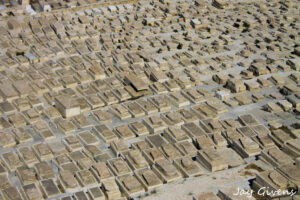
Graveyard at the Mount of Olives (Photo by J.M. Givens Jr. Used by permission).

The cry from the stones

Not only was the donkey Jesus’ rebuke of violent revolution, but his statement that the stones would cry out was not about the stones of Jerusalem’s walls. As noted before, Luke emphasizes the crowd was going down the Mount of Olives into the Kidron Valley.

This area, both then and now, was a vast Jewish graveyard. There were stones everywhere, in front of tombs as well as atop crypts.

The stones themselves would not be crying out: “Hosanna! Save us!” Rather, it would be the dead behind those stones shouting out for Jesus to remember them when he came into his kingdom.

In Zechariah, there is a promise from God attached to the one who rides the donkey: “Because of the blood of my covenant with you, I will free your prisoners from the waterless pit” (Zechariah 9:11).

Jesus’ decision to be a priest-king and to sacrifice his life would result in the salvation of those in the grave—the waterless pit—as well as those of us yet to die.

This Prophet like Moses would not liberate the people from slavery to an occupying force. His exodus would lead people out of the grave. This Messiah had not come to defeat the Romans. He would destroy the common enemy of all people—death itself.

Jesus wept because he knew many there that day rejoicing in his enactment of a messianic claim ultimately would reject his servant-priest-king conception of what it meant to be Messiah. Instead, they would follow after various revolutionaries who rose up before and after him, until the Romans eventually had enough and destroyed Jerusalem and the temple in A.D. 70.

As with the “triumphal entry,” Jesus’ whole life was a repudiation of power politics and cultural wars. Jesus foresaw the exaltation of religious nationalism as the destruction of his people … and he wept. When will American Christians put off the power dynamics of Cain and put on the servant righteousness of Jesus the Messiah?

Jay Givens is professor of theological studies and director of online Christian studies programs at Wayland Baptist University. This article is adapted from the original blog post and republished by permission. The views expressed are those of the author.


Voices: My position on Law’s list of SBC churches

Mike Law Jr., senior pastor of Arlington Baptist Church in Virginia, with wide support among some members of the Southern Baptist Convention, recently posted a list of churches affiliated with the denomination who have women on staff with “pastor” in their titles.

This move by Law and others in the SBC is a continuous part of their movement to control—and alienate—women who feel the call to serve in Christ’s church. As a male member of a Baptist church with female ministers, I feel the need to respond.

The list against women in ministry

Law notes his list includes churches “listed on the churches.sbc.net website” and “the SBC Workspace database.” He also explains: “Local and State Associations often relate to the SBC on a national level, so there is an open question of whether they are considered to be in friendly cooperation with the Southern Baptist Convention for the purposes of seating messengers.”

Law admits he has “not examined all of the churches in the Southern Baptist Convention. These are either churches I personally discovered along the way of writing to the SBC Executive Committee, churches who disclosed their female pastors to me through correspondence, or churches who were brought to my attention through colleagues.”

In a previous letter, Law called for unity in the SBC on the issue of women as pastors. To that end, he made a motion at the 2022 SBC annual meeting to amend the SBC’s constitution to define a church in “friendly cooperation” as one that “does not affirm, appoint, or employ a woman as pastor of any kind.” More than 2,000 people have signed their support of this letter.

Law and those in the SBC who agree with him seem to want to relegate women out of pastoral roles. While I believe they base their positions in Scripture, there are many examples in the Bible of women leading God’s people and men affirming that leadership.

Paul on women in ministry

Paul’s first letter to Timothy is used as one argument against women leading in ministry—specifically teaching and having authority over men in the church. Reading Paul’s letter so as to exclude women in authoritative/teaching roles is inconsistent with the Pauline corpus in general.

The SBC has, for a majority of its history, had no quarrel with women teaching children and being missionaries. Law’s list—which contains many children and family pastors—only proves his issue is semantic, which does not constitute a faithful reading of Paul.

The word Paul uses in the 1 Timothy passage concerning women not being permitted to teach is didasko—“to teach” (1 Timothy 2:12 NRSV). The issue here for many who advocate for women in ministry is that Paul consistently refers to women who are in church leadership in his other letters.

Paul uses many words to describe women who were serving the churches he wrote to throughout his ministry. For examples, I’ll use his letter to the Romans.

Paul refers to the woman Phoebe with the title diakonon—“servant/deacon/minister”—during the concluding chapter of Romans (Romans 16:1). In the same chapter, Paul describes a woman named Junia as an apostle, using the phrase episemoi en tois apostolois—“notable/well-known among the apostles” (Romans 16:7).

In this usage of apostolois—“apostles”—Paul has ranked Junia as a prominent leader in the church, as seen in his first letter to the Corinthians. In 1 Corinthians 12:28, Paul ranks church leadership in such a manner: proton apostolous, deuteron prophetas, triton didaskalous—“first apostles, second prophets, third teachers.” Thus, Paul ranks this woman named Junia over the prophets and teachers of the church.

Paul also mentions in 1 Corinthians 11:5 that women are able to prophesy. The word propheteuousa—“to prophesy”—exists in the space of the church, not just for men, but for women, as well. This means Paul affirms women to the second line of church leadership, as well, using his ranking from 1 Corinthians 12.

Old and New Testament women

Throughout the Old Testament, women are viewed in leadership positions in ancient Israel. While there are occasions in which female leadership in the Old Testament is not portrayed positively, these examples should not be used to undermine the positive influence female leaders embody in the Old Testament.

Miriam (Exodus 15:20) and Huldah (2 Kings 22:14) are called neviah—“prophetess.” Deborah is the female judge who led Israel—she “was judging Israel” (Judges 4:4)—and is called neviah—“prophetess.”

Furthermore, one must consider the prophet Joel’s words from God: “I will pour out my spirit on all flesh; your sons and your daughters shall prophesy” (Joel 2:28 NRSV, emphasis mine).

Jesus allowed women to serve during his ministry. Mary Magdalene and Mary the mother of James are said to have “followed him and kai diekonoun auto—“provided/served him” (Mark 15:40-41). They were among the followers at the death scene of Jesus (v. 40).

Women followed Jesus along with the Twelve who diekonoun autois—“provided/served”—“them from their resources/goods” (Luke 8:1-3).

Jesus spoke to the Samaritan woman at the well (John 4:27-30, 39-42). Upon giving her townsfolk her martyrouses—“testimony/declaration/solemn appeal” (John 4:39)—people were saved by him.

The Bible mentions women in ministry of all types in many instances. Paul, whose texts have played a significant role in the argument against women in ministry, affirms women to church leadership. Ancient Israel had prominent women leaders. Jesus our Lord allowed women to be a part of his ministry.

Messengers to the 2023 SBC annual meeting in June will vote on whether to “oust” the churches on Law’s list. If Law and his supporters are successful, these churches will continue to be faithful to the message of Scripture.

Let the ministry of women be a light in the darkness, and let these women called by God be a city on a hill that cannot be shaken. May the Lord bless women in ministry and church leadership—in the name of the Father, the Son, and the Holy Spirit. Amen.

EDITOR’S NOTE (June 20, 2023): A link to Mike Law’s list was removed after the list was used to harass women and churches named in it.

REVISED (April 13, 2023): The original article published April 3, 2023, was revised by the author to provide additional references and clarifications. Additionally, Editor Eric Black transposed the Greek terms diakonon (referring to Phoebe) and apostolois (referring to Junia) in the original published article. That error has been corrected.

EDITOR’S NOTE: The two documents linked in this article were downloaded, respectively, from a Google Docs file shared by Mike Law and the “What is a Pastorwebsite. Baptist Standard does not vouch for the accuracy of either document, both of which may be updated or taken down by their author at any time.

Nathan Patzke is a Master of Divinity student at Baylor University’s Truett Theological Seminary and a graduate assistant at Baylor’s Beauchamp Addiction Recovery Center. He assists with college worship, Bible studie, and Sunday morning worship at his church in Central Texas. The views expressed are those of the author.


Voices: Universities must adjust to change, too

Higher education gets news coverage in both mass and social media. Much, I’m sure, is true. Technology is changing it at warp speed, and the old descriptions we used to toss about no longer fit.

We joked that colleges had buildings where “ivy is creeping around on the outside and teachers are creeping around on the inside.” Other bromides come to mind, but none seem to fit well in the ever-changing framework of what higher education is all about.

Greek philosophers considered the topic centuries ago, asking, “Whom, then, shall we call educated?”

Then, they proceeded to answer their own questions, claiming education should enable students to deal effectively with the circumstances they encounter day by day. It still fits, right?

Normal colleges

Truth to tell, institutions must be open to change. After all, many of them have changed their names, and several times at that. What formerly were known as “teachers’ colleges” head the list.

When colleges started popping up in Texas—most of them in the early 1900s—a word included in most names was “normal.

Real old-timers, longest of tooth and grayest of beard, remember or heard tell of such colleges—including Sam Houston State Normal College—with these three last names also applying to such institutions as North Texas, Southwest Texas, Sul Ross, East Texas and West Texas.

They removed “normal” from their names, a decision perhaps worthy of applause. Many changed their three final words to “State Teachers’ College.” Then came “State College,” followed by “State University.”

During the 1960s and 1970s, many colleges decided “university” had a better ring to it. Later, some joined the systems of two other institutions—The University of Texas and Texas A&M University.

Fort Worth higher ed

I want to focus on unusual happenings at two Fort Worth institutions of higher education—Texas Christian University and Southwestern Baptist Theological Seminary.

Both provided recent front-page stories mere days apart in the Fort Worth Star-Telegram.

TCU leaders promised placement of the “big pot into the little one” for its 150th anniversary observance this year. Southwestern announced the sale of Carroll Park—a 24-acre tract with one- and two-bedroom housing—to the City of Fort Worth for $11 million.

Though Texas Christian University has been the official name since 1902, founding brothers Addison and Randolph Clark called TCU “Add-Ran Male and Female College” in the early years.

About the time of TCU’s founding 150 years ago, Fort Worth was saddled with bawdiness associated with the joint impact of railroads and Chisholm Trail cattle drives. Afraid this setting could corrupt students’ minds, the Clark brothers relocated the school to Thorp Spring, some 40 miles away and a few miles from Granbury.

Enrollment grew there from a few dozen students to more than 400 from 1873 to 1895. It was known for being “seven miles from any known sin.”

Then TCU relocated to Waco. In 1910, TCU moved back to Fort Worth, where the sprawling campus of some 300 acres now is home to some 11,000 students. It may be the only higher education institution in the United States that has been located in three communities, one of them twice.

Southwestern’s property sale is a head-scratcher, particularly since this was the world’s largest theological seminary during the 1970s and 1980s.

News accounts indicate Fort Worth plans to utilize the housing for homeless families. When Christ returns, his arrival might be at the very spot where Cowtown homeless abide.

University presidents

Presidents of higher education institutions these days seem to be on ground as shaky as football coaches whose school alumni promise to “support them always—win or tie.”

Average presidential tenure now is about four years, and Kenneth Ashworth—longtime Texas Commissioner of Higher Education—saw the entanglements coming.

Fact is, presidents are re-reading his delightful 2001 book Caught Between the Dog and the Fireplug: How to Survive Public Service.

Don Newbury, retired president of Howard Payne University, writes weekly and speaks regularly. This article is adapted from his regular column, ‘The Idle American.’ Newbury can be contacted via email: newbury@speakerdoc.com; phone: (817) 447-3872; Twitter: @donnewbury and Facebook: Don Newbury. The views expressed are those solely of the author. Published by permission.