Supreme Court considers potentially major church-state case

WASHINGTON—The U.S. Supreme Court heard oral arguments Jan. 22 on a case prompted by a Montana program that offered tax credits to people who funded scholarships in private schools—including religious schools.

The Montana Supreme Court ruled the program violated a provision in the state’s constitution that bars government financial aid—direct or indirect—to religious schools.

Kendra Espinoza, whose children attend Stillwater Christian School in Kalispell, Mont., and who would have benefited from the dollar-for-dollar tax-credit program, challenged that prohibition.

“I feel that we are being excluded simply because we are people of religious background or because our children want to go to a religious school,” Espinoza told reporters on the steps of the Supreme Court.

The Southern Baptist Convention’s Ethics & Religious Liberty Commission and the Baptist Joint Committee for Religious Liberty have taken opposing views on the case, Espinoza v. Montana Department of Revenue.

Call for neutrality

Kendra Espinoza, lead plaintiff in a church-state case being considered by the U.S. Supreme Court, responds to questions from reporters. (BJC Photo)

The ERLC joined the Christian Legal Society, the U.S. Conference of Catholic Bishops, the National Association of Evangelicals and 13 other organizations in a friend-of-the-court brief filed Sept. 18 urging that the Montana Supreme Court decision be reversed.

The brief argues that when a tax-credit program benefits both religious and non-religious schools on neutral terms, any legal rule that excludes religious beneficiaries unfairly discriminates against them. It claims such exclusion violates principles of government neutrality and private choices in matters of religion.

“The fact that religious schools ultimately benefit from families’ and donors’ exercise of choice cannot justify application of a provision that singles out religious choices for exclusion,” the brief states.

Protect religious schools from government intrusion

On the other hand, the BJC argued in its friend-of-the-court brief that prohibitions on public funding for religious institutions—including schools—“protect the distinctiveness of religion and promote values that advance religious freedom.”

“The no-funding principle is historically and practically related to limits on government interference in religion and public accountability for public resources,” the brief states.

The brief emphasized the distinctive legal treatment of religion protects religious liberty by keeping the government from interfering in its beliefs and practices, including the spiritual formation of students in religious schools.

“Petitioners’ demand for a state program for equal funding ignores the distinctiveness of religion and the various ways religious education operates to promote faith formation. It ignores the relationship between support and accountability in public programs and the limits on governmental interference in religion,” the brief states.

The BJC brief—joined by the Evangelical Lutheran Church in America, the General Synod of the United Church of Christ and the stated clerk of the General Assembly of the Presbyterian Church (U.S.A.)—urged the Supreme Court to affirm the Montana court’s ruling.

‘Neither surprising nor discriminatory’

“States should not have to fund religious schools. Religion is treated in a unique way in constitutional law, both to avoid its establishment by government and to avoid government interference in its free exercise. This special treatment of religion stems from our country’s deep and abiding commitment to religious liberty for all,” Holly Hollman, BJC general counsel said.

Holly Hollman

“The Supreme Court has long recognized that government may not directly fund religious exercise. So it is neither surprising nor discriminatory that Montana’s constitution, like those in other states, protects religious liberty by avoiding even the indirect funding of religion. No-aid provisions ensure that state funds are preserved for state purposes and not used to advance religion.

“The court should reject blanket attacks on no-aid provisions and uphold Montana’s law that preserves public funding for its public schools.”

At least three dozen other states have provisions similar to the one in Montana that prohibits state aid to fund religious education.

Rooted  in anti-Catholic bigotry?

In a friend-of-the-court brief, the U.S. Department of Justice claims the prohibitions grew out of a failed amendment to the U.S. Constitution that Congressman James G. Blaine proposed in 1875. The brief asserts the state prohibitions were adopted “during an era of widespread hostility to Catholicism in general and to Catholic schools in particular.”

The BJC brief rejects that assertion, saying it “misrepresents a long tradition of noninterference with religion” dating back more than two centuries, and it insists there is no evidence the Montana constitutional provision was “enacted out of religious animus.” It notes 19 of the 38 no-funding provisions in states predated the Blaine Amendment.

“The origins of the no-funding principles predate not only the Blaine Amendment but also the advent of significant Catholic immigration in the 1840s,” the BJC brief states.

In a separate friend-of-the-court brief, Americans United for Separation of Church and State similarly emphasized state prohibitions on public funding of religious education are designed to protect the independence of religious groups from government interference.

“The founders believed that it was critical to protect individuals’ freedom of conscience against the coercive extraction of tax funds to support religion,” the brief states.

Texas Impact—an interfaith public policy network—joined Americans United and more than a dozen other religious and civil liberties groups in filing the brief.


Editorial: In our search for justice, can justice be found in us?

Three men were arrested for plotting to start a civil war. Senators are in the midst of an impeachment trial to decide the future of Donald Trump’s presidency. The Sussexes shocked everyone with their surprise announcement of stepping back from royal duties.

These are just three headlines among scores with a common thread: a search for justice in these days.

But whose justice?

Differing perspectives on justice

In the case of the plotting men, they desire racial justice favoring white people. Their hope stands in stark contrast to Dr. Martin Luther King Jr.’s work for justice, celebrated just days after the three men were arrested.

Dr. King gave his life working to ensure African Americans can enjoy the same dignity and rights as their white counterparts. He didn’t just deliver rousing and quotable speeches. He was beaten, jailed and eventually murdered as he worked for justice, which included calling oppressors to account.

In the case of the president of the United States, again there are two versions of justice. One version wants the president to answer for his actions by being removed from office. The other version wants to safeguard the presidency from political attacks seen as undermining the office of the president.

Both sides are hanging their reputations and political careers on their pursuit of justice. Neither side is staking their lives, but they are calling one another to account.

As for the royals, the young couple simply wants to live a normal life, whatever that is. Prince Harry, the Duke of Sussex, wants better for Meghan Markle and Archie than his mother received.

Having grown up in the shadow of his mother’s death, blamed by justice seekers on the paparazzi, Harry wanted “a more peaceful life” for his family. If peace requires a royal to leave the palace, then for Harry and Meghan the choice is peace. According to Isaiah, peace and justice go hand in hand (Isaiah 59:8).

Tabloids told of the monarchy bristling with “fury” because it wasn’t consulted or notified before the Sussexes broke the news to the public. Bristling is what people do in response to a perceived injustice. For the monarchy, peace—and by extension, justice—requires not rocking the boat.

We all want justice … on our terms

Describing the above perspectives on justice as I have may give them the appearance of being equal. Are these differing views of justice on par with one another? No.

Each view places, or privileges, one person or group of people over another. Any view of justice that privileges one person or group of people over another is not justice. Justice is derived from God’s law, and the Bible repeatedly declares God does not show favoritism.

Herein lies a significant part of the trouble with justice in this world: When is one person or group of people privileged over another? We all want justice—and privilege—but we more easily see ourselves as wronged than as privileged. We know when we have been wronged, when we’ve been the recipient of injustice, but we don’t always agree that someone else has been wronged.

The result of this disagreement over wrongs is a ratcheting up of tensions and offenses as the offender and the offended seek justice. Tit for tat becomes eye for an eye becomes Sherman’s march to the sea. A current example of this back and forth search for justice is being played out between the United States and Iran. What will it take for both to achieve justice? We are afraid to find out.

Our place on the long arc of justice

The back and forth of seeking justice is worked out not just over a single lifetime but spans generations. People have been seeking justice on their own terms since Cain and Abel. This is why the Middle East is entrenched in conflict. This is why Dr. King’s work was so hard and was resisted so stridently. Four hundred years of slavery and oppression leaves a lasting wake.

Coming back to the three examples above: What do we have to do with failed civil war plans, pending impeachment decisions and royal family relations? Can we have any effect on these kinds of things? More than we might realize.

Rather than dismissing our influence because it seems so small in comparison to such big stories, we might consider a more accessible example, like the brawl at the end of the Kansas vs. Kansas State basketball game on Jan. 21. A brawl is about seeking justice. The way justice was sought in that moment is a reflection of character. What lifelong influences were revealed by those players in those few seconds of fighting?

Forming the character of children who will become basketball players seen by millions of people on TV can be an act of justice.

Will justice be achieved when all white supremacists are arrested, impeachment decisions conclude correctly or royal families get to live normal lives? Hardly.

Justice is a long arc because it is made of all the things we do to give rise to racial injustices, government corruption, family disputes and athlete misbehavior. Justice is a long arc because it is made of all the things we do in the wake of such things.

Justice also is a long arc because it is made of what average people do on an average day. And what an average person does on an average day is an expression of that person’s character. And character doesn’t suddenly appear; it develops.

Giving attention to our own search for justice

We would do well, then, to give attention to our own character more than the misdeeds of others. Are we people of love, joy, peace, patience, kindness, goodness, faithfulness, gentleness and self-control—qualities against which there is no law (Galatians 5:22-23)?

Or are we the kind of people who either turn a blind eye to racial injustice or encourage it through propagating stereotypes, systemic biases and violence against others? Are we the kind of people who tolerate misbehavior by politicians because it’s the lesser of two evils? Are we the kind of people who idolize the famous to the point of devouring them? Are we the kind of people who make winning at all cost the supreme value?

Our character produces our actions—or fruit, to use the biblical metaphor—and our fruit will show us for what we are. The fruit of our character will bend the long arc either toward or away from justice.

To God’s people, the “Lord Almighty said: ‘Administer true justice; show mercy and compassion to one another. Do not oppress the widow or the fatherless, the foreigner or the poor. Do not plot evil against each other.’” (Zechariah 7:9-10). To do these things requires deep and godly character.

In our search for justice—and we’re all seeking it—can justice be found in us?

Eric Black is the executive director, publisher and editor of the Baptist Standard. He can be reached at eric.black@baptiststandard.com or on Twitter at @EricBlackBSP. The views expressed are those solely of the author.


Evan Duncan: The One Maker

Baptists Preaching is a column from the Baptist Standard. It is not an effort to advance any one theology or style but to present what a collection of Baptists considers a word from God. Likewise, Baptists Preaching offers a repository of Baptist preaching for future study and research. To recommend a sermon to be featured in Baptists Preaching, please contact eric.black@baptiststandard.com.

Evan Duncan: The One Maker (Ephesians 4:1-6)

Evan Duncan, teaching and communications pastor of First Baptist Church in Temple, Texas, preaches about how the Holy Spirit enables Christians to walk together. One of the biggest challenges for Christians is how to do life together, especially as different cultures and statuses come together. The world notices when Christians are divided, and Scripture says the world also will notice when Christians are united.

Duncan notes, “Christian unity is not uniformity.” He explains the character traits of Christian unity, originating in the Holy Spirit and listed by Paul in his letter to the Ephesians.

This sermon was delivered on June 23, 2019, during the modern worship service at 11:00 a.m. at First Baptist Church in Temple. It is the last of a series titled “The Holy Spirit.”

EDITOR’S NOTE: Evan Duncan serves on the board of directors of Baptist Standard Publishing Company.


Voices: We are shaped by a river of small churches

The abandoned locks of the Middle Brazos River weren’t always so forlorn. Once proud engineering feats standing as the economic hope of a region, today they are reduced to lonely piles of masonry and metal crumbling back into the earth. Some, like the site near Hearne, spend their afterlife silently watching the river. One near Waco has been afforded no such dignity. Instead the Brazos changed its course until Lock and Dam No. 8 was exiled to a pasture south of town, forgotten by both the river and those who tried bending it to their will.

The Brazos River in Central Texas

Central Texans in the late 19th and early 20th centuries had a complicated relationship with the Brazos. They depended on it for natural resources but cursed its floods and lack of reliable navigation, while lashing out at the prehistoric alligator gar patrolling its waters.

This portion of the river is plagued by shoals and inconsistent water levels. At times, a packed canoe could struggle to find enough water for passage, let alone the mighty steamboats laden with cotton seen elsewhere.

That didn’t stop decades of river surveying and snag clearing by those who believed the longest river fully within Texas’ borders could rival the industrial rivers of the East and compete with new railways spidering across the country. These aspirations crested with the implementation of locks designed to flood hazards until boats could safely pass.

The Brazos, for its part, was utterly uncooperative in this grand design, alternating between granting too little water for the locks to function and blasting them out of the way with historic deluges.

When the first World War called upon the nation’s engineering forces, the plan to build Waco into a great port city was carried away by Rio de los Brazos de Dios, the Arms of God.

Small churches in Central Texas

I’ve spent the last decade in Waco as a student, educator and preacher, catching a glimpse of that cantankerous river almost every day. During my residency along the Brazos, I’ve been around small churches far more than I ever expected, both pastoring a small church for a few years and filling empty pulpits across Central Texas.

Sometimes a pastor simply is out for the day. Other times, a church has been unable to retain a shepherd for months or years. They hope someone can pass through with a word from the Lord one Sunday at a time.

These little churches scatter across ideological and cultural spectrums. They can be wasting away from spiritual illness or bursting with a vitality for which larger churches cry out in their cavernous sanctuaries. Yet they all have something in common. Each small church is attended exclusively by people whom God loves.

Misunderstanding small churches

I must confess: I’m not sure some of us have done our best job loving these churches and their people, and I number among the errant. I’ve come to realize smaller churches are like the Brazos River.

Those of us accustomed to medium and large churches are prone to rush in with glorious visions of contorting a church into something it is not, forcing it to flow our way until the whole thing collapses around us. If you know how to see the damage, finding churches where that has happened is easier than finding the ruined Brazos locks.

When our plans fail, we like to run to other ventures, leaving our ruined machinations high and dry. Those who pass by later judge the churches and the river based on the forlorn piles of our aspirations.

We miscalculate and dismiss these churches as something lesser than, or we simply don’t bother to darken their doors. We deem them muddy rivulets where we toss young ministers to see if they’ll get big enough for our needs.

Real rivers, we think, support mighty ships, flow reliably and teem with noble gamefish. Likewise, we think real churches have a multipurpose recreation space, a bustling calendar and the kind of “who’s who members” who look good in brochures.

According to these standards, the Brazos is a failure of a river, and over half of America’s churches don’t count in the kingdom. Yet, God made no mistakes when etching the Brazos, and the Spirit doesn’t need surround sound to show up.

It’s bittersweet to leave Texas and return to my native side of the Mississippi, but I’m not leaving without a great reservoir of memories and a lasting lesson in God’s sense of importance.

I hope we can silence our assumptions and let these churches keep teaching us wherever we are.

The Brazos River and God’s grace will keep flowing as designed; God is honored when we cherish both.

Geoff Davidson, an alumnus of George W. Truett Theological Seminary, is a minister and writer leaving Waco to minister in the Jackson, Miss., area.


Larry Floyd: ‘An opportunity every day to make a difference in people’

Larry Floyd became executive director of the El Paso Baptist Association in October 2019. From deep in the heart of one Texan, he shares his background and thoughts on associational ministry and the church. To suggest a Baptist General Convention of Texas-affiliated leader to be featured in this column, or to apply to be featured yourself, click here.

Background

Where else have you served in ministry, and what were your positions there?

I served as youth pastor at Mount Carmel Baptist Church in Cleburne (1998–1999), First Baptist Church in Azle (1999–2002) and First Baptist Church in Spearman (2002–2003).

I also served as youth and education pastor at Lakeshore Drive Baptist Church in Weatherford (2003–2007) before transitioning to administration and education pastor (2007–2013).

I then served as senior pastor at First Baptist Church in Del Rio (2013–2015). I started a new church as lead pastor, City Church Del Rio (2015–2019).

Where did you grow up?

I was born in Des Moines, Iowa but moved to El Paso when I was 9 years old. I consider El Paso my hometown.

How did you come to faith in Christ?

In 1989, I was given a grim health report, and this actually was the catalyst to my search for truth, which led me to Jesus. My wife was praying for me as she had come to a saving faith in Christ just a few months before me.

I was in church listening to the sermon when I knew Jesus was calling me to his side. I missed the invitation call, but I made the benediction call. The invitation had come and gone, and I believed I had missed my salvation opportunity. During the benediction blessing, the pastor stopped and asked if anyone else wanted to be saved, and it was then I went and received Jesus for myself. It ain’t over truly until God says it’s over. This was Jan. 14, 1990.

I am amazed even to this day of the power of God’s love over me.

Where were you educated, and what degrees did you receive?

I have two theology degrees from Southwestern Baptist Theological Seminary.

About ministry life

Why do you feel called into ministry?

It is a sense of spiritual insideness that has me in vocational ministry. It is really hard to explain, except that I know he has beckoned me to serve him fully as a minister of the gospel. I have always tried to follow wherever he has led me. I have been to the Panhandle, the Rio Grande border, the Dallas-Fort Worth Metroplex, Houston and now El Paso. Only God could have orchestrated that type of obedience.

What is your favorite aspect of ministry? Why?

The one thing I love most about ministry is people. I thrive on people interaction. I love how God has created so many differences in us, and yet we can become united because of Jesus.

I believe we have an opportunity every day to make a difference in people because we have been called to minister. Without people we have no calling.

What one aspect of ministry gives you the greatest joy?

Being a friend of pastors and leaders. Ministry can be a lonely place at times. I hope to be a true friend that pastors can call on for any needs they have.

What one aspect of ministry would you like to change?

I think the biggest thing in ministry today that needs to change is our concept of what makes a church. Church needs to become all things to all people in order to save a few. Gospel-centered ministry needs to be threaded throughout our methods and modes more than ever before.

How has your ministry or your perspective on ministry changed?

Having come to Christ as an adult, I was pretty black and white when it came to almost all areas of my life. I have come to realize Jesus works in the margins, and there is a lot of gray in ministry. Gray lets us be obedient to God and not have to know every detail of what he is calling us to do. Clarity is really clear until we obey the first step. Then that step gives way to clarity in the calling of each of our ministries.

How do you expect ministry to change in the next 10 to 20 years?

I listen to and read a lot of Thom Rainer, so I am a little biased. Bi-vocational ministry will be the norm, not the exception, as the struggle for resources becomes more and more evident in church life.

If you could launch any new ministry—individually, through your congregation or through another organization—what would it be? Why?

A non-traditional, non-Sunday worship service, where the outcasts could come and be “incasts.” Our desire to reach the unchurched and the outcast has become non-existent in our modern-day worship.

Name the three most significant challenges and/or influences facing your ministry.

Making associational work relevant, resources to do ministry, and working together with two Texas conventions.

About Baptists

What are the key issues facing Baptists—denominationally and/or congregationally?

Baptists have been known to be a people of the Book (the Bible). I am not sure that is still the case. I wish there was an all-out cry and outpouring of the teaching of all of Scripture, even the difficult passages.

About Larry

Who were/are your mentors, and how did/do they influence you?

One of my mentors is Dr. Mark Kemp, senior pastor of First Baptist Church in Copperas Cove. He taught me how to love the church if we were going to be “in ministry.”

Rev. Patrick Six, senior pastor of Scotsdale Baptist Church in El Paso, taught me how to love my staff.

What did you learn on the job you wish you learned in seminary?

I wish the teaching was more geared for the reality that we would be serving in smaller churches since the majority of Texas churches are under 100 in attendance.

What is the impact of ministry on your family?

My family has been so amazing. I have tried always to remember God gave me my family before I had the ministry. I always have made time for them and have had to say, “No” to a lot of offers from well-meaning church members.

Other than the Bible, name some of your favorite books or authors, and explain why.

• Thom Rainer. I love statistics that tell a story of reality.
• Gary Chapman, because of simplicity for sharing and pouring into other people’s lives.
• Rick Warren, because he is so encouraging in his books.

What is your favorite Bible verse or passage? Why?

1 John 1:7, because it says we have fellowship with one another. I believe we need to fellowship so we can serve together.

Who is your favorite Bible character, other than Jesus? Why?

Peter. He wasn’t afraid to try. He failed in many areas but learned from them and became a pillar of the church. He never let his failures define him.

Name something about you that would surprise people who know you.

First, I speak pretty fluent Spanish. Second, I was a dental hygienist when God called me into ministry.

If you could get one “do over” in ministry, what would it be, and why?

If I could do anything over, it would be to have started as soon as I sensed God calling me into ministry. I waited and struggled for five years with the calling.


Voices: What would love do? Dr. King and the transforming power of love

I have been invited twice to speak at Trinity Baptist Church in San Antonio as part of their Martin Luther King Jr. celebration. The last time I spoke, I thought I would include some of San Antonio’s own racial history in my speech.

While I was researching for my speech, I found a map of San Antonio’s racial segregation in housing from the 1940s. The segregation had been created by a process called “redlining,” where the federal government-backed Homeowner’s Loan Corporation (HLOC) developed a rating system to evaluate the risks associated with home lending in certain neighborhoods.

For decades the HLOC rated neighborhoods with African Americans as higher risk, which led to divestment from those neighborhoods. In San Antonio, both the West Side (Hispanic neighborhoods) and the East Side (African American neighborhoods) were rated as high risk.

As I shared with the folks assembled for the luncheon, the effects of the decades-old policy was still evident. The neighborhoods that had been disadvantaged due to racial prejudice all those years ago still have lower performing schools, lower educational attainment and higher rates of mortality. In fact, one study I found showed a 20-year difference in the average lifespan between San Antonio’s wealthy and poor neighborhoods.

The church’s response to Dr. King’s cause

I share this information for the same reason I shared it with Trinity. As we commemorate Dr. Martin Luther King Jr., we must remember that the cause for which he was murdered remains unfinished. In addition to the lingering effects of centuries of racial discrimination, racial hatred and prejudice is alive today.

The question before the church remains the same as in King’s day, “How will we respond?” Will the church be “an arch defender of the status quo?”

In “A Letter from a Birmingham Jail,” Dr. King lamented church leaders who “stand on the sideline and mouth pious irrelevancies and sanctimonious trivialities” while others work to end racial and economic injustice in this country. He wrote to men and women who say those are “social issues, with which the gospel has no real concern.”

The truth, however, is for a disciple of Jesus Christ there is no issue in life with which Scripture is not concerned.

Scripture’s position on justice

Over and over again in Scripture, we are told justice matters to God. In the Old Testament, the prophets from Isaiah to Amos declare judgment over the people of Israel for their failure to keep God’s commands to provide justice to the poor and the marginalized.

The command to do justice is serious to God. In fact, he rejected the worship of those who had neglected his command, instead calling for “justice to roll down like waters, and righteousness like an ever-flowing stream” (Amos 5:21-24).

In the New Testament, Jesus condemns the Pharisees who had been faithful tithers but “neglected the weightier matters of the law: justice and mercy and faith” (Matthew 23:23).

Orthopraxy is a reflection of our orthodoxy.

Justice in the way of Dr. King

To post Dr. King quotes but be silent and sit on the sidelines in the face of injustice is to dishonor his legacy. More importantly, it dishonors God.

Jesus commanded his followers first to love the Lord with all our hearts and minds and second to love our neighbor as ourselves. Dr. King believed in the supernatural power of love to transform hearts and minds, and also unjust systems and laws.

For Dr. King, love and justice were linked inextricably. “Love that does not satisfy justice is no love at all … love at its best is justice concretized,” he said.

In Scripture, the story of the good Samaritan illustrates that to love your neighbor is to see their humanity, their struggles, their hurts, and to take action to remedy the harm regardless of your role in the actual perpetration of the harm. 1 John 3:18 reminds us we are to love “not with words or speech but with actions and in truth.”

The church’s response to Scripture’s cause

How will the church respond in the face of injustice?

Trinity Baptist Church formed a Micah 6:8 committee to look at the ways the church could become more involved in addressing injustice in their city.

Every church and every Christian will respond differently to the “Macedonian call for aid,” as Dr. King called it in his “Letter from a Birmingham Jail.” Dr. King traveled from the projects of Chicago to the steps of the Lincoln Memorial to the streets of Birmingham and Memphis. The road was not easy. He was beaten, surveilled, stabbed and ultimately murdered.

Dr. King believed love was the only way. He saw in Scripture that we were transformed from God’s enemies to his children through the power of God’s love for us. He believed only love could transform hate.

He responded, not with the weapons of the world, but with the only weapon he knew powerful enough to allow the lion and the lamb to lie together as friends, to turn a persecutor to the author of half of the New Testament, and to bring the dead back to life.

While Dr. King’s work remains unfinished, his chief weapon remains. The question for us is: Will we pick love up and fight the injustices of our generation?

Kathryn Freeman, former director of public policy for the Texas Baptist Christian Life Commission, is a student at Baylor’s Truett Seminary. She remains passionate about Jesus, justice and discipleship.


Lanny Hall to begin chemotherapy for lymphoma

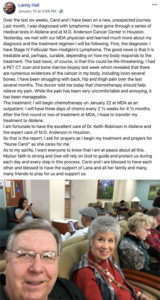
HOUSTON—Lanny Hall, past president of three Texas Baptist universities, has been diagnosed with lymphoma and will begin chemotherapy at M.D. Anderson Cancer Center in Houston on Jan. 22.

In a Jan. 15 Facebook post, Hall announced that over the previous six weeks, he and his wife Carol had “been on a new, unexpected journey.”

“Last month, I was diagnosed with lymphoma,” he wrote.

After a series of medical tests in Abilene and in Houston, the couple met with a physician at M.D. Anderson on Jan. 14 to learn more about the diagnosis and recommended treatment.

“I have Stage IV Follicular Non-Hodgkin’s Lymphoma,” Hall wrote. “The good news is that it is treatable and, perhaps, curable, depending on how my body responds to the treatment. The bad news, of course, is that this could be life-threatening.

“I had a PET CT scan and bone marrow biopsy last week which revealed that there are numerous evidences of the cancer in my body, including in/on several bones.”

Hall reported back, hip and thigh pain over the past several months, which he described as “very uncomfortable and annoying” but “manageable.”

He will begin treatment Jan. 22 as an outpatient at M.D. Anderson, receiving three days of chemotherapy every two and a half weeks for four and a half months. After one or two rounds of treatment in Houston, Hall noted he hopes to transfer to Abilene for the duration of his chemotherapy regimen.

Prayer requested

“I ask for prayers as I begin my treatment and prayers for ‘Nurse Carol’ as she cares for me,” he wrote.

Hall added he is “at peace about all this,” saying his faith is strong and adding he and his family “will rely on God to guide and protect us during each day and every step in this process.”

Hall served more than a quarter-century as a university president at three Baptist General Convention of Texas-affiliated schools—Hardin-Simmons in Abilene, Howard Payne in Brownwood and Wayland Baptist in Plainview.

At HSU, he actually served two terms as president—from 1991 to 2001 and again from 2009 to 2016—along with a stint as HSU chancellor from 2001 to 2003.

Hall served three terms in the Texas House of Representatives, and also worked as a congressional aide, a public school educator, a state agency executive and a university professor.


Editorial: Welcome to God’s one big estranged family

My son and I are reading through the Bible together on YouVersion’s Bible app. Beyond reading all the way through the Bible, it’s giving us a way to grow our relationship.

Since we’re still in January, we’re not out of Genesis yet. This means we are reading a lot about families and family feuds, which is interesting to read together as a family.

We have talked about how important families and family histories are to God, important enough to include genealogies and family dirt in the Bible.

There’s Cain and Abel, Noah’s sons, Abraham and Lot, Isaac and Jacob, Jacob and Esau, Jacob and Laban, Joseph and his brothers, among others. In each of these relationships, there is an estrangement. In several, there is a bitter dispute and parting of ways.

I am struck by how, from the start, people who started as one family quickly developed a pattern of estrangement. And these are God’s people. These are the people Christians claim as their ancestors in the faith and look to as models of faith. This is the family we join when we become followers of Christ.

This estranged family is the family we invite others to join by becoming followers of Christ.

Welcome to the family, God’s one big estranged family!

Where estrangement begins

Yes, we have followed well our models in the faith. We have found a multitude of things to disagree over. Some of these disagreements have led us to bitter disputes and even separation.

Granted, some of our disagreements are over significant differences. We don’t see eye-to-eye on sexuality or women leading in the church. Some of these disputes can make it hard to sit down and eat together.

Other disagreements don’t rise above the color of the carpet but are fueling our inability to stomach one another. I’m talking about our political differences. Where Christians once seemed able to discuss their political differences with civility, there is disgust. Just look at social media. Or better yet, don’t. Christians are behaving very badly there.

The disagreement is not the problem, however. The problem is that we allow the disagreement to become the center. Once at the center, disagreement becomes a pattern, a habit. It becomes formative. We become known by what we disagree over, because disagreement shapes our behaviors and our relationships. We are so shaped by disagreement that we are dividers in the world, estrangers.

The problem is not that we disagree. The problem is that we disagree to the point of estrangement. And once we separate, we add insult to injury and revile one another. All the while, the world we want to invite into the family of God is watching. No wonder they’re not interested.

Arguing over the family Bible

Our penchant for disagreeing is played out many places, including in our approach to the Bible. We each insist we understand the Bible correctly. To describe our biblical correctness, we may use terms like “faithful,” “traditional” or “orthodox.”

We each claim to be reading the Bible faithfully or to have a traditional or orthodox understanding of the Bible. This is code for: “We’re right. You’re wrong.”

People shaped by disagreement tend not to be willing to give any ground on their degree of correctness, especially biblical correctness. An unintended consequence is an inability to submit to the Scripture they claim as authoritative because they’re too consumed with being right.

By the way, we’re all either susceptible to or guilty of this—fundamentalists, conservatives, moderates, liberals and progressives alike.

Christians say their mission is the Great Commission: “Go and make disciples of all nations …” (Matthew 28:19-20). The problem for Christians comes at the point of “teaching them to obey everything I have commanded you.”

We don’t agree on the particulars of what exactly is commanded, and we stake out our turf accordingly. Rather than submitting to the Scripture, we set up Scripture as a line between us and we post guards so that “none shall pass.”

The lines of biblical correctness become walls. To leave is to betray. To get in is to defile. Estrangement runs headlong into dysfunction.

Rather than being centered on the Great Commission, Christians seem to spend much more time, energy and resources on arguing over who understands the Bible correctly. The result is split after split, schism after schism.

Catholics and Protestants have done it. Lutherans have done it. Presbyterians have done it. Episcopalians and Anglicans have done it. Methodists are doing it. Baptists, well, we’re experts.

All the while, we claim to be going and making disciples, but those we’re inviting to join the family are shaking their heads. They see us more clearly than we see ourselves.

Unbreaking the circle

I can describe where we are, but I’m also caught up in the estrangement. I’ve also considered my reading of the Bible more correct than others. I’ve also struggled to “hang out” with those unlike me. I’m supposed to move beyond description to prescription here, aren’t I?

Here is where I will change the subject.

Each day in the Bible app includes a Gospel reading. Today, we read Matthew 12:1-21, which concludes with a quote from Isaiah 42:1-4:

“Here is my servant whom I have chosen,
the one I love, in whom I delight;
I will put my Spirit on him,
and he will proclaim justice to the nations.
He will not quarrel or cry out;
no one will hear his voice in the streets.
A bruised reed he will not break,
and a smoldering wick he will not snuff out,
till he has brought justice through to victory.
In his name the nations will put their hope.”

Maybe I didn’t change the subject after all.

Eric Black is the executive director, publisher and editor of the Baptist Standard. He can be reached at eric.black@baptiststandard.com or on Twitter at @EricBlackBSP. The views expressed are those solely of the author.


Rev. Ronald Session: Offended by Grace

Baptists Preaching is a column from the Baptist Standard. It is not an effort to advance any one theology or style but to present what a collection of Baptists considers a word from God. Likewise, Baptists Preaching offers a repository of Baptist preaching for future study and research. To recommend a sermon to be featured in Baptists Preaching, please contact eric.black@baptiststandard.com.

Rev. Ronald Session: Offended by Grace (Jonah 4:2)

Rev. Ronald Session, pastor of Shiloh Church in Garland, Texas, preached to the difficulty of grace right after Amber Guyger was sentenced to 10 years in prison after being convicted of murder in the fatal shooting of Botham Jean. He wondered how Brent Jean and Judge Kemp could hug Guyger. Jonah helped him work through the difficulty. Session preaches through the book of Jonah to give context to Jonah’s criticism of God, to explain the extent of grace and to apply those lessons to today.

This sermon was delivered on Oct. 6, 2019, during the morning worship service at Shiloh Church in Garland.


Voices: Pro-life voting involves more than one issue

I don’t know about you, but I’m tired of hearing people support a political candidate based on one issue—abortion.

I suggest three reasons why it’s a problem to make abortion the one and only campaign issue.

It’s dishonest

People who choose to use the term “pro-life” rather than abortion are not being honest with themselves or anyone else. If a person truly is “pro-life,” then he or she would oppose equally capital punishment, war and indiscriminate gun ownership—all pro-life issues.

I don’t know of anyone in the pro-life movement who believes abortion, capital punishment and war should be eliminated and guns severely restricted. I doubt they really are pro-life.

If a person honestly wants to be pro-life, then continue advocating for eliminating abortion while also standing up against capital punishment, identifying as a conscientious objector and advocating for stricter gun control laws.

To be especially serious about pro-life, a person also should work to eliminate poverty, demand health care for everyone and work to stop climate change.

In fact, to be pro-life, the list is almost endless: drive the speed limit and follow all safety laws, speak out against the tobacco industry, seek ways to help people fight obesity, stop posting hateful messages on social media, demand fair treatment of immigrants and people of all races.

It’s dumb

One-issue political supporters essentially are saying nothing else matters: “Take us to war, eliminate Social Security, be immoral and dishonest, raise taxes and ignore every other problem. I don’t care. As long as you claim to be anti-abortion, you have my vote.”

It sounds ridiculous when put like that, but it’s precisely what has happened. We have countless officeholders with nothing to offer except a claim to be against abortion. We have politicians in place who know they are safe and can do whatever they want because they were elected for one position. They know people will vote for them regardless of anything else they do.

This includes the incumbent President of the United States.

It doesn’t work

Single-issue voting simply doesn’t work. The rationale, proven over and over to be flawed, is that an anti-abortion president will create an anti-abortion Supreme Court supported by an anti-abortion Senate and House and will be able to eliminate abortion. Wouldn’t it be nice if all the right people were in place to test the theory?

From 2001 to 2007, Republicans—the ones who say eliminating abortion is their number one priority—controlled the presidency, House and Senate and had a conservative Supreme Court. During that time, they did not pass legislation to overturn Roe v. Wade. With executive, congressional and judicial sway in 2017 and 2018, again nothing was done to eliminate abortion.

At this point, a single issue—abortion—voter ought to ask, “Why?”

Perhaps it’s time to apply the definition of insanity to this process: “Insanity is doing the same thing over and over and expecting a different result.” It just might be insane to vote for a politician solely because he or she claims to be anti-abortion. In addition to the fact that it’s not going to eliminate abortions, it also means people keep voting for candidates who have nothing else.

After seeing what Republicans have done with their power since 2001, it’s clear they are not going to do anything about abortion. Republicans have found a fluffy toy that distracts voters whenever necessary.

Where I am on the one issue of abortion

In the same way that anti-abortion people chose the term pro-life to identify their position, the other side chose pro-choice because it always is better to be “for” something than to be “against” something. As we already have seen, being pro-life doesn’t necessarily mean a person stands for all things contributing to and strengthening life.

To be labeled pro-choice doesn’t mean a person always supports abortions. Personally, I consider myself anti-abortion and pro-choice. What I mean by that is I would not choose abortion for myself—an easy choice for me, someone who will never get pregnant—but I think others should have the choice for themselves.

In most cases, if a woman came to me for advice for herself, I would strongly encourage her to consider life and make her choice prayerfully.

In extreme circumstances, such as doctors knowing for certain the baby in her womb already is brain dead, I would be OK with abortion. I am not OK with abortion as an option in response to something as simple as forgetting to use contraception.

These are not easy choices, but I do support a woman’s right to be the one to make the choice. Being pro-choice does not mean I’m pro-abortion.

I’ve never met anyone who goes around meeting with pregnant women just to suggest they have an abortion, though there might be a few who do. I’ve never heard a political candidate advocate in favor of abortions, and I never would support one who did.

The only way to eliminate abortions is the same way to eliminate wars, capital punishment, poverty, lack of healthcare, gun violence and other problems. It will only happen when all of us live in harmony and demonstrate love to one another, following Jesus—the One who shows us what it means for God to walk among us.

Terry Austin is a graduate of Wayland Baptist University and Southern Baptist Theological Seminary. He has been a pastor and church consultant and is managing partner of Austin Brothers Publishing. This article is adapted from Austin’s blog. The views expressed are those solely of the author.


Dr. Edward Wagner: From a military career to God’s call

Dr. Edward Wagner has been senior pastor of Cornerstone Baptist Church in Killeen since 1996. From deep in the heart of one Texan, he shares his background and thoughts on church and ministry. To suggest a Baptist General Convention of Texas-affiliated minister to be featured in this column, or to apply to be featured yourself, click here.

Background

Dr. Wagner was pastor of Gospel Congregation at West Point from 1980 to 1982, pastor of Camp Red Cloud Korea from 1986 to 1987, assistant pastor of Providence Missionary Baptist Church from 1990 to 1992 and assistant pastor of Comanche Chapel from 1992 to 1995.

Where did you grow up?

I grew up in Rayville, La.

How did you come to faith in Christ?

I had a Sunday school teacher, Ms. Della Woods, who taught me about Christ and never gave up on me. When I did not go to Sunday school, she would come and find me and bring me to Sunday school.

Every day, I walked by her house on my way from public school. She would call me onto her porch and make me read the Sunday school lesson to her. She lived a Christian life and she modeled Christ in my life. This led me to accept Christ into my life.

Where were you educated, and what degrees did you receive?

• Bachelor of Science in mathematics from Southern University
• Bachelor of Science in civil engineering from Louisiana Tech
• Master of Arts in management from Webster University
• Master of Arts in civil engineering from Louisiana Tech
• Ph.D. in philosophy of religion from Trinity Theological Seminary

About ministry life

Why do you feel called into ministry?

My calling was an experience I shall never forget. I was reading the book of Revelation, and I began to cry as I read about the “End-Times.” The Lord spoke to me clearly and told me he was calling me to the ministry. I was not accepting at first because I had a great military career, and I had planned to spend 40 years in the military. Each assignment after that, the Lord placed people into my life to confirm his calling; so, finally in 1978, I accepted the call.

What is your favorite aspect of ministry? Why?

My favorite aspect of ministry is preparation—when I spend time with the Holy Spirit and he speaks clarity into my spirit—so I can preach with clarity and simplicity.

What one aspect of ministry gives you the greatest joy?

Helping people. It may be helping them understand a Scripture with which they have been struggling, helping them heal a broken marriage, helping them reconcile a broken relationship or helping them just by listening. I get so much joy out of helping people.

What one aspect of ministry would you like to change?

Nothing! There is nothing I would like to change. Sure, I have challenges, but I have learned to accept challenges are just God’s way of growing me and building my character.

How has your ministry or your perspective on ministry changed?

I used to assume every preacher I met was just as loyal and devoted to the call of Christ as I am. I no longer have that assumption, and that has led me to work to get them to that place.

Do you mentor anyone?

Yes, I do. I mentor several young ministers. I have teaching meetings with them twice a month and have breakfast with them once a month.

How do you expect ministry to change in the next 10 to 20 years?

I expect we will have smaller congregations, or at least smaller groups within the church body, because needs are increasing constantly, and the level of biblical knowledge within the general population is decreasing constantly. Therefore, the structure of the church must change in order to meet those needs.

If you could launch any new ministry—individually, through your congregation or through another organization—what would it be? Why?

A health ministry because I find we are not taking health seriously. Young people are spending too much time with video games and social media, and the rest of us are not getting proper exercise and taking care of our health.

Name the three most significant challenges and/or influences facing your ministry.

1. Leadership—getting all of the leaders to embrace servant leadership.
2. Leadership—getting the right people on the bus and in the right seat on the bus.
3. Leadership—functioning without a sense of entitlement, not thinking you are entitled to a level of respect different than that which you give simply because you are the president of the auxiliary.

What do you wish more laypeople knew about ministry or, specifically, your ministry?

I wish they knew the love and passion I have for the people of God, the hours I spend in prayer for them.

About Baptists

What are the key issues facing Baptists—denominationally and/or congregationally?

Change is the greatest issue facing us denominationally. We must not get stuck in a paradigm. We must embrace change and work to have change work for us.

Congregationally, I think the key issue we face is being relevant. The young generation has many questions, and one of their main questions is, “How does this relate to me?” Therefore, we must be focused on application as we preach the word of God.

What would you change about the Baptist denomination—state, nation or local?

I would have the national convention model what Texas Baptist are doing. I sincerely believe we here in Texas have it right. We are a convention that is inclusive and celebrate our diversity.

About Dr. Wagner

Who were/are your mentors, and how did/do they influence you?

Dr. Author S. Kubo was my greatest mentor. He had a great work ethic, he was constantly working to improve himself, and he had great respect for the contributions of others. He influenced me to take an assignment to teach at the military academy at West Point. This assignment prepared me for the ministry because I learned how to teach at West Point.

What did you learn on the job you wish you learned in seminary?

How to use the Logos software.

Not very much. My road to ministry came through the military. I spent almost 22 years as an officer in the military. You learn a lot when leading men and women, and that experience gave me a great education.

What is the impact of ministry on your family?

The impact has been all positive for me. I have a wonderful wife of 49 years who appreciates the fact that I get to come home every day. It was not always the case during those years in the military.

I have three children who know the power of prayer and never hesitate to call dad when they need spiritual counseling. I have six grandchildren who are growing up to know Christ. It cannot get any better.

Other than the Bible, name some of your favorite books or authors, and explain why.

• Good to Great by Jim Collins
The 15 Invaluable Laws of Growth by John Maxwell
The Audacity of Hope by Barack Obama
Soar With Your Strengths by Donald O. Clifton
A God-Centered Church by Henry Blackaby
The Culture Code by Daniel Coyle

I am an avid reader. Reading is my greatest pastime. I mostly read books about leadership, because I believe this is what the church needs most. My second reading interest is books that inspire, encourage and compel people to action.

What is your favorite Bible verse or passage? Why?

Galatians 2:20. It keeps me humble knowing who I belong to and the price he paid for me.

Who is your favorite Bible character, other than Jesus? Why?

Jeremiah the prophet. His life was a “pedagogy in biography.” It took great discipline to do the things God told him to do; yet, he faithfully did those things.

Name something about you that would surprise people who know you.

I was a high school quarterback.

If you could get one “do over” in ministry, what would it be, and why?

I would have accepted my calling much sooner than I did.


International evangelist met Christ in a Texas prison

Looking back, Rick Vasquez sees how God constantly moved around him and watched over him throughout his life, even when he faced danger and skirted death.

As chief executive officer of the Houston-based Texas Evangelist Ministry, Vasquez travels internationally, telling others why they should give their lives to Christ.

Vasquez, who also is pastor of Iglesia Crosspoint in Bellaire, hopes that by telling what God continues doing in his life, others will learn from his testimony of God’s fidelity.

Learning early not to trust people

As a child of divorced parents growing up in a low-income household, Vasquez quickly learned to distrust most people. Men, in particular, took advantage of his mother and their situation. So, when a new man showed up in his mom’s life, Vasquez knew he only would stick around as long as it was convenient.

Lacking guidance or supervision, Vasquez also learned to take what he needed to survive, even if it was not his. At 12 years old—after stealing sandwich bread, bologna, chips and drinks from his neighbor to feed his sisters—Vasquez was incarcerated the first time.

From then until age 34, Vasquez went in and out of prison constantly. It would not take long after his release from prison for him to end up back inside. So, most of his understanding of life and maturity into adulthood took place in prison.

His perception of men was reaffirmed, but he also began particularly to mistrust men in prison who professed to be Christians.

“While they gathered together to pray and read the Bible, they would very quickly also come to me and ask for illegal substances and adult material,” Vasquez said.

His distrust of others also worsened, and he turned to violence. Eventually, Vasquez said, he became the leader of one of the prison system’s most notorious gangs.

Hearing God’s voice

Rick Vasquez came to faith in Christ in 1994 after hearing God’s voice in his prison cell. Now as pastor of Iglesia Crosspoint and evangelist at West University Baptist Church, Vasquez longs to tell others about Christ.

Before long, correctional officers decided placing Vasquez in solitary confinement was the best way to protect their safety and that of the other inmates.

But in prison, Vasquez said, he began hearing the voice of God more and more clearly.

In unexpected ways, Vasquez realized God kept calling him, over and over. At some point while listening to the song “Nothing Else Matters” by the heavy metal band Metallica, he finally realized he found no trust in anyone around him.

In contrast to the song, which speaks of a deep relationship between two people, Vasquez recognized he had no one like that in his life.

“As the song was ending I heard this voice at the end of this guitar solo that said, ‘Trust and follow me,’” Vasquez recalled. “That is not part of the song, and it freaked me out, but it still echoes to this day.”

Suddenly, Vasquez felt the presence of God all around him and realized he urgently needed to change his path. He heard the convicting voice of God calling him to follow.

Realizing his life was full of sin and he needed help, Vasquez said, he was told in a dream he had to be honest and admit the help he sought could come only from God.

“I understood that if I had asked for help, then I needed to trust and follow God unless I wanted to be like the fake people I hated,” Vasquez said. “So, I got on my knees and said: ‘Here I am. Show me what to do.’”

New life in Christ

The following 10 years he spent in prison, Vasquez devoted his time to studying the Bible and learning as much as he could about the Christian faith.

“I studied a lot of systematic theology, encyclopedias, Bible commentaries and everything else I could get my hands on,” he said.

Books from Chuck Swindoll, Tony Evans, R.C. Sproul among others served as his path towards knowledge and understanding of the faith.

Around that time David Tamez—who would eventually serve as associate director of Texas Baptists’ River Ministry and now is president of Seminario Teologico Bautista Dr. G.H. Lacy in Mexico—began a prison ministry. Under a prison mentoring program, Tamez came to mentor Vasquez in his spiritual walk.

“He invested time in me, and I still call him my mentor,” Vasquez said.

After Tamez, other teachers and mentors who knowingly and unknowingly taught Vasquez began noticing his passion.

Swindoll’s Spanish publishers contacted Vasquez and informed him he had ordered more material in Spanish than anyone else. That drew their attention, and they continually prayed for him, representatives of the publisher told him.

Called to serve

Throughout his learning process, Vasquez sensed a new calling from God. While he grew up speaking English at home, in prison he saw the treatment non-English-speaking Hispanics received. So, he decided to learn more Spanish in order to help those inmates.

Evangelist Rick Vasquez travels to Latin America, where he supports ministers and shares the gospel.

In the early 2000s, Vasquez was released from prison, and he quickly sought areas to grow more in his Christian walk and serve in ministry. His background in prison and his passion for discipleship led him to evangelism and church starting.

About five years ago, after Roger Patterson, pastor of West University Baptist Church and Crosspoint Church, reached out to him, Vasquez joined his staff.

At the time, Patterson told Vasquez about a vision he had. Patterson dreamed of reaching 10,000 people with the gospel by 2020, and he thought Vasquez could be part of it.

Vasquez joined Patterson in the effort, offering support and guidance. By the end of 2019, they had reached more than 20,000.

“We surpassed the goal by the grace of God,” Vasquez said.

As an evangelist, Vasquez said, his call not only involves presenting the gospel to others, but also helping Christians learn how to tell others about Jesus.

Vasquez evangelizes, trains and disciples in countries across Latin America, and he ministers to families of incarcerated people. He also continues planting churches and ministers to people migrating to the United States.

Encounter with heavy metal songwriter

Nineteen years after God spoke to Vasquez through a heavy metal song, a friend from California called him and informed him he had seen songwriter James Hetfield at a church. The writer of the song God used to touch Vasquez’s heart had grown up in a religious home but had not been in church since he was 12 years old.

“I knew he was searching when he walked into that church, just as I was searching when I listened to his music,” Vasquez explained.

Hetfield agreed to meet with Vasquez, who shared his Christian testimony with him. After the two talked for a while, Vasquez said Hetfield reached out his hand and told him, “Let’s do it.”

“He received the very hope and healing I received when I bowed my knees in a Texas prison,” Vasquez said.