Texas no longer is the national capital of capital punishment, but it still is among the handful of states responsible for about three-fourths of the executions carried out in 2025, a report from the Death Penalty Information Center revealed.
With 18 executions carried out this year and another scheduled this week, Florida was responsible for more than one-third of the executions nationwide, according to the center’s report, “The Death Penalty in 2025: Year End Report.”
Florida, Alabama, South Carolina and Texas combined accounted for 72 percent of all executions in the United States in 2025, the report noted.
The Death Penalty Information Center reported 46 prisoners executed in 11 states in 2025, with two more scheduled: Stacey Humphreys in Georgia on Dec. 17 and Frank Athen Walls in Florida the following day.
“The increase in this year’s execution numbers was caused by the outlier state of Florida, where the governor set a record number of executions,” said Robin Maher, executive director of the Death Penalty Information Center.
“The data show that the decisions of Gov. DeSantis and other elected officials are increasingly at odds with the decisions of American juries and the opinions of the American public.”
The center reported public support for capital punishment at the national level is at its lowest point in five decades at 52 percent. Polls also show generational differences, with a majority of people younger than 55 disapproving of the death penalty.
Texas put five prisoners to death in 2025
Texas executed five Death Row prisoners in 2025: Steven Nelson, Richard Tabler, Moises Sandoval Mendoza, Matthew Johnson and Blaine Keith Milam.
Two other men—David Wood and Robert Roberson—were scheduled to be put to death but received stay of execution orders from the Texas Court of Criminal Appeals.
“After decades as the nation’s death penalty pariah, Texas was not the lead executioner this year. … Yet the state continues to waste millions of taxpayer dollars in the pursuit of capital punishment while glaring problems with its application persist,” the report states.
This year, Texas judges set the fewest execution dates in at least 30 years, and prosecutors increasingly waived the death penalty in capital murder trials due to costs and the lengthy and uncertain legal process, the coalition reports.
Embracing ‘mercy and reverence for human life’
John Litzler, public policy director for Texas Baptists’ Christian Life Commission, said he was encouraged by “what appear to be declines across the board of both executions and new death penalty sentences in Texas.”
John Litzler
“The history of capital punishment in Texas is fraught with prejudice, disproportionality and error,” Litzler said. “For that reason, the reduction of capital punishment sentences carried out in Texas shouldn’t be viewed as a rejection of justice, but a state that embraces both mercy and reverence for human life.
“As Texas Baptists continue to share their beliefs that all human life is sacred because every person is made in the image of God, I expect the number of executions in our state to continue to decrease. That’s because living in a community and state that values human life compels us to approach potential death sentences with humility and restraint.
“This is reflected in the practices of our district attorneys who are seeking the death penalty as a punishment less often and also in the decisions of our juries who are more often choosing life without parole as a criminal sentence, even with capital punishment as an option.”
This year, prosecutors in only two Texas counties pursued death sentences, the coalition report notes.
“In Texas, whether a person receives a death sentence continues to be driven not by the underlying crime, but by geography,” the report states. “Only prosecutors in Harris and Tarrant counties pursued new death sentences in 2025, with juries sending three men to death row while rejecting the death penalty in a fourth case.”
‘Past time to kill the death penalty’
Death sentences in Texas have fallen from 48 in 1999 to single digits each of the past 11 years, the report notes.
The coalition report urges policy makers “to examine the collective costs of capital punishment and to follow the lead of Texans who are increasingly abandoning the death penalty as a path to justice.”
Stephen Reeves
“It is well past time to kill the death penalty,” said Stephen Reeves, executive director of FaithWorks, formerly known as Fellowship Southwest. “While the decrease in executions and new sentences in Texas is encouraging, it only highlights the arbitrary and capricious nature of the punishment.
“Even seldom and random state vengeance carried out on the poor, unlucky, marginalized and forgotten members of society does nothing to make us safer and is simply cruel and unjust. Let’s finally abolish the death penalty and get Texas out of the ineffective, expensive and immoral business of killing our citizens.”
Nan Tolson, director of Texas Conservatives Concerned About the Death Penalty, called the death penalty, “a wasteful and expensive system with life or death consequences.”
Costs involved in carrying out an execution—including investigations, trials, appeals, prolonged incarceration and the execution itself—make the death penalty two to three times more expensive than a sentence of life without parole, said Tolson, a Baylor University graduate.
“Texas should embrace a vision of justice that leaves the death penalty behind and reallocates limited public resources to measures proven to improve public safety,” she said.
Texas policymakers need to “examine the collective costs of capital punishment”—including the moral cost of people being executed for crimes they did not commit, she added.
“As conservatives, we don’t trust the government to deliver our mail on time, much less get convictions right all the time in death penalty cases,” Tolson said.
Baylor receives major Lilly grant for Truett Seminary
December 15, 2025
WACO—Baylor University received a $9.76 million Lilly Endowment grant to launch and provide financial support for the Ministry for Life initiative at Baylor’s Truett Theological Seminary.
The Ministry for Life initiative is funded through Lilly Endowment’s Pathways for Tomorrow Initiative. The grant to Baylor University is one of 45 approved in this competitive round of Lilly Endowment funding to support theological schools as they lead large-scale collaborations with other seminaries, colleges and universities, and church-related organizations.
Truett Seminary’s Ministry for Life initiative is based on a collaborative, comprehensive approach to pastoral formation intended to span the ministerial lifecycle.
The program is organized around four related pillars:
Shaping cultures of call.
Educating the called.
Placing the educated.
Supporting the placed.
The grant-funded effort aims to build reciprocal relationships among leaders, congregations, denominations, educational institutions and church-related organizations through the Ministry for Life Center with a view to equipping healthy ministers to lead healthy churches over the long haul.
Addressing a ‘systemic concern’
Todd Still (Baylor Photo)
“For a number of years now, several of my Truett colleagues and I, along with many of our ministerial partners, have grown increasingly concerned about a decreasing number of people embracing and preparing formally for vocational ministry and an increasing number burning out and dropping out of the same,” Dean Todd Still said.
“This generous, indeed transformative, grant from Lilly Endowment, which is the largest such gift Truett Seminary has received to date, enables us to collaborate with others to address this systemic concern.
“At scale, we are convinced that Ministry for Life will have a considerable impact and will help to create and establish virtuous ministerial cycles that will extend the gospel and strengthen congregations.”
Truett’s Ministry for Life program—which is due to become an endowed, permanent center at the seminary—will be supervised by Truett faculty and staff members Angela Reed, associate dean of academic affairs and director of spiritual formation; Jack Bodenhamer, assistant dean of external affairs; and Michael Mauriello, associate clinical professor of youth and family ministry. The five-year grant will allow for staff hires to support the initiative’s work.
Collaborative effort, holistic approach
“We are beyond grateful for this opportunity to build upon the work of teaching and encouraging those with a call to ministry by developing new collaborative degrees and academic certificates, mentoring young people drawn to ministry leadership and walking alongside pastors already serving for the long haul,” said Reed, who is the grant’s principal investigator.
“No theological school does this work alone, and we are very pleased to collaborate with denominations, educational institutions, and nonprofit organizations in this project to support faithful, healthy congregations for God’s purposes in the world.”
Additionally, Bodenhamer, co-investigator on the grant, said Truett Seminary is confident the grant “will help shape the landscape of the church in North America for generations to come.”
“Its holistic approach—supporting ministers, churches, denominations, educational institutions and para-church ministries—positions us to serve individual pastors and congregations while also fostering meaningful change at a broader systemic level,” he said.
Strengthen churches and their leaders
The Ministry for Life initiative reflects Baylor’s “abiding commitment to the church in North America and to equipping future leaders for vibrant, lifelong ministry, not least through our seminary,” President Linda A. Livingstone said.
“We are deeply grateful for the Lilly Endowment’s continued partnership with Baylor University and for their faithful investment in the renewal of the church and support of congregations. We look forward to continuing this good work together to strengthen the church and support its leaders, both for today and for future generations.”
Lilly Endowment launched the Pathways for Tomorrow Initiative in 2021 to help theological schools across the United States and Canada as they prioritize and respond to the most pressing challenges they face while preparing pastoral leaders for Christian congregations now and into the future.
Since then, it has provided grants totaling more than $700 million to support 163 theological schools in efforts to strengthen their own educational and financial capacities and to assist 61 schools in developing large-scale collaborative endeavors.
BUA organiza el retiro ‘Llamados al Ministerio’
December 15, 2025
Bajo la dirección del presidente de BUA, el Dr. Abe Jaquez, el campus de la Universidad Bautista de las Américas en San Antonio, Texas, se llenó de energía y ánimo los días viernes 5 y sábado 6 de diciembre, cuando los bautistas de Texas se reunieron para el retiro “Llamados al Ministerio”.
Este evento de dos días ofreció un espacio acogedor para que los participantes exploraran, afirmaran y respondieran al llamado de Dios a través de sesiones de enseñanza, talleres y tiempo de compañerismo.
Uno de los momentos más destacados del retiro se vivió el sábado, cuando la Dra. Debbie Potter, recientemente elegida presidenta de la Baptist General Convention of Texas y miembro de largo tiempo del cuerpo docente de BUA, dirigió unas palabras a los asistentes y entregó una beca de $500 a John Mendoza, un estudiante prospectivo.
Con entusiasmo, Potter entregó el certificado de la beca, marcando un momento memorable del retiro y subrayando la importancia continua de la educación, el liderazgo y la respuesta fiel al llamado de Dios en todos los ámbitos de la vida.
Presentada por Jaquez, Potter compartió un mensaje que combinó testimonio personal, ánimo y sabiduría práctica para quienes están discerniendo el llamado de Dios.
“Esta es mi primera tarea oficial como presidenta de la Baptist General Convention of Texas, y no podría estar más emocionada de estar aquí porque también es mi hogar”, dijo Potter.
“He enseñado en BUA durante 10 años, de manera intermitente. Mi esposo empezó a enseñar aquí primero, y volvía a casa todos los lunes por la noche comentando sobre los estudiantes y lo increíbles que eran; estaba tan emocionado con ellos.
“Varios de esos estudiantes vinieron a trabajar conmigo en mi iglesia y todavía trabajan conmigo, 10 años después, en Trinity Baptist. Los estudiantes de este campus y los líderes son tan importantes, y eso marca la diferencia. Eso es lo que me encanta de la Baptist General Convention of Texas: que valoramos la educación”, agregó.
Basándose en sus reflexiones sobre el valor de la educación y el impacto de los estudiantes de BUA, Potter animó a los asistentes a confiar en el plan de Dios para sus vidas, sin importar su edad o experiencias pasadas:
“No importa cuántos años tengas, ni lo joven o lo viejo que seas, ni lo que hayas hecho en tu vida, Dios tiene un plan para ti, y esos planes pueden cambiar,” dijo Potter.
“Mi primer llamado fue hacia la educación. Soy educadora. Me encanta enseñar, ya sea a niños o a estudiantes universitarios. Él me pidió que enseñara, y lo hice.
“Así que hoy solo quiero animarte: no dejes que nada te detenga de seguir el plan de Dios para tu vida. Puede que no sepas cuál es; puede que tome varios giros y curvas. Solo di que sí, y Dios abrirá la puerta para ti.
“Solo mira alrededor de esta sala y piensa en lo que puede suceder en nuestro estado si todos decimos sí al llamado de Dios y comenzamos a trabajar en nuestras comunidades y nuestras iglesias.”
El retiro también contó con un programa completo de sesiones generales y talleres. La tarde del viernes comenzó con Victor Rodríguez dirigiendo la sesión “¿Qué significa ser llamado?”, en la que destacó que Dios no necesariamente llama a los más calificados, sino a los dispuestos, y que el llamado puede darse en cualquier área de la vida: la iglesia, el trabajo, la familia o los negocios.
Rodríguez animó a los participantes a asumir la tarea de Dios con fidelidad, recordándoles que las Escrituras reflejan no solo tareas, sino el propósito que Dios tiene para cada persona.
Las sesiones del sábado incluyeron a Bobby Contreras con la enseñanza “Protegiendo tu llamado”, enfocándose en hábitos y disciplinas que sostienen el ministerio, y a Jesse Rincones con “Llegando lejos en tu llamado”, destacando la perseverancia y la resiliencia.
Los talleres estuvieron dirigidos tanto a pastores como a quienes están discerniendo un llamado, abordando temas desde el papel de la iglesia en el desarrollo de líderes emergentes hasta el discernimiento personal y el impacto en el Reino.
Durante todo el fin de semana surgió un tema recurrente: Dios llama a personas de todas las edades y contextos para servir, y responder fielmente puede tener un impacto duradero. Para muchos, la combinación de enseñanza, compañerismo y ver a líderes como Potter en acción brindó tanto inspiración como ánimo tangible para sus propios caminos.
BUA hosts Called to Ministry retreat
December 15, 2025
Texas Baptist youth gathered Dec. 5-6 on the Baptist University of the Américas campus in San Antonio for a Called to Ministry retreat.
Organizers planned the two-day event to offer a welcoming space for participants to explore, affirm and respond to God’s calling through teaching sessions, workshops and fellowship.
In her first official task as president of the Baptist General Convention of Texas, Debbie Potter presented a $500 scholarship to prospective student John Mendoza.
Potter, children’s pastor at Trinity Baptist Church in San Antonio, told retreat participants about her personal involvement with BUA.
“I’ve been teaching at BUA for 10 years on and off. My husband first started teaching here, and he would come home every Monday night and talk about the students and how incredible the students were. He was so excited about them,” Potter said.
“Several of them came and started working for me at my church and still work for me, 10 years later, at Trinity Baptist. The students on this campus and the leaders are so important, and that’s what makes the difference. And that’s what I love about the Baptist General Convention of Texas—it’s that we value education.”
‘God has a plan for you’
Potter urged attendees at the retreat to trust God’s plan for their lives, regardless of their age or past experiences:
“No matter how old you are, no matter how young you are, no matter what you have done in your life, God has a plan for you, and those plans can change,” she said. “My first calling was to education. I am an educator. I love teaching, whether children or college students. He asked me to teach, and I did it.
“So, I just want to encourage you today. Don’t let anything deter you from doing God’s plan for your life. You may not know what it is. It may take several different turns and curves. Just say ‘yes,’ and God will open the door for you.
“Just look around this room and think about what can happen in our state if we all say ‘yes’ to God’s calling and start working in our communities and our churches.”
Victor Rodriguez, evangelism associate and discipleship specialist with Texas Baptists, led a session focused on the question, “What does it mean to be called?”
God calls not necessarily the most qualified but the willing, Rodriguez said. God’s calling can come in any area of life—from the church to the workplace, family or business, he added.
Rodriguez encouraged participants to embrace God’s assignment with faithfulness, reminding them Scripture reflects not just tasks, but the purpose God has for each person.
Bobby Contreras, pastor of Alamo Heights Baptist Church in San Antonio, led a session on “Guarding Your Calling.” Jesse Rincones, executive director of the Hispanic Baptist Convention of Texas, presented a session on “Going the Distance in Your Calling,” emphasizing perseverance and resilience.
Willimon offers Advent reminders to Texas pastors
December 15, 2025
Advent should remind justice-minded Christians their “yearning” and “longing for more” is rooted in the awareness God’s kingdom has come, but it also is yet to come, theologian Will Willimon told religious leaders on a Zoom call convened by Pastors for Texas Children.
Christians live “in the meanwhile” between Christ’s first advent as a baby in a manger and his second advent when he returns to set right all that is wrong, said Willimon, a former United Methodist bishop.
So, observing Advent reminds the church “what we need most we don’t have,” he observed.
‘Take the longer view’
In times of discouragement and defeat, Advent reminds Christians to keep the end in mind rather than focusing on the disappointment of the present moment, he asserted.
“There come those times when the discouragement is so deep, and it seems like the opposition is so effective against us, that we have to take the longer view,” Willimon said.
He made that observation when the Zoom call resumed after temporarily being disrupted by a malicious hacker.
Some of the “pushiest prophetic poetry” in the Hebrew Scriptures that focused on hope grew out of the exile in Babylon, Willimon said, citing the late Old Testament scholar Walter Brueggemann.
Consider the scope of the gospel
“The good news of Jesus Christ is more than personal. It’s more than subjective. It’s more than individualistic,” Willimon said.
In an “aggressively subjective, individualistic culture,” Christians need to be reminded of the scope of the gospel, he asserted.
“This thing with Jesus is more than personal. It’s cosmic,” Willimon said. “Your little heart is too small an arena for what God is busy doing. … Everything is being turned upside-down so it can be turned right-side-up.”
The prevalence of bad news may be opening up the possibility for good news, he suggested.
Advent challenges Christians to hold loosely to temporary human systems and structures, because God is at work doing something on a grander scale, he insisted.
“In some of the dismantling that is going on, some of the letting go that I’m being forced to do that I find very, very painful, is God maybe in some of that, too, so that something new can come?” he asked.
In fact, he suggested, “God may be taking away some false idols.”
‘God is doing a new thing’
Without a long-term, Advent-informed view, Christians who strive for justice and goodness find it “hard to keep at it,” Willimon acknowledged.
However, the Advent message centers on the idea: “God is doing a new thing among us,” he insisted.
Kyle Childress, recently retired pastor of Austin Heights Baptist Church in Nacogdoches, asked Willimon how his preaching has changed since he began in the ministry. Willimon replied he gradually has learned to “take the long view.”
“I hope that the long hope we have—who has a name and a face, Jesus Christ—gives us enough short-term hope to keep working for the good and for others,” Willimon said.
“I do know we have a relentlessly redemptive Savior.”
Children deserve the best, BGCT president asserts
December 15, 2025
“The children are the church now,” not just the church of the future, newly elected Baptist General Convention of Texas President Debbie Potter remarked in a phone interview.
Potter was elected president at the BGCT annual meeting in Abilene in November, after previously having served as both second vice president and first vice president.
Her election marks the first time a children’s pastor has served as BGCT president, she observed, noting the role most frequently has been filled by senior pastors or institutional executives. She also is the first ordained woman elected as president of the BGCT.
Potter has served 22 years as children’s pastor at Trinity Baptist Church in San Antonio after previously serving six years at Parkhills Baptist Church, also in San Antonio, where she was licensed to the ministry. Additionally, she teaches at Baptist University of the Américas.
Her drive to serve children and families has kept Potter in ministry even through difficult times.
“I get asked on a regular basis: ‘Why are you still here?’” she said.
She noted that being in her early 60s, some assume retirement is just around the bend for her, but Potter said she doesn’t see it that way.
On the contrary, Potter said she feels like she’s “just getting started,” though she noted she also is intentional about empowering up-and-coming ministry leaders to lead, within the children’s ministry department she oversees.
She is excited to lead the churches of the BGCT to do more to ease suffering among children and families in Texas, Potter noted.
Some recent government changes in Texas have increased needs among already vulnerable populations, she asserted.
“Our children and families are hurting,” Potter said, and she believes BGCT churches can do more to help.
Her own church, for example, has taken an active role in supporting families in their community by providing beds for infants and lockboxes to reduce accidental deaths from co-sleeping or kids getting into medications, she explained. Participants in Trinity Baptist’s Vacation Bible Schools have raised money for these causes through their offerings.
Potter also noted she personally provides support to Child Protective Services workers to aid them in performing some of the difficult duties only they are qualified to do.
“The BGCT does some great work,” Potter said, mentioning lobbying for policies and laws that “give children a voice” in Texas through the Christian Life Commission as an example.
“If we don’t help these vulnerable children, the Bible’s pretty clear,” she added. “These are the least of these. Jesus commands us to do this.”
So, she hopes the somewhat different message she will bring to the BGCT will lead to greater advocacy for children among the churches.
Controversy surrounding being an ordained woman
Potter said debate on social media surrounding her election was somewhat surprising, noting she told her husband, “I had no idea I was this interesting.”
But, she said, she has assured everyone who has expressed concern: “I knew what I was doing. My whole ministry has had these type of things.”
Unknown people on the internet who don’t know her or anything about her don’t bother her much, although when those who are close to her speak out against her ministry it does cause pain.
She finds the social media drama around her election somewhat “comical,” she said—that “I’m worth fighting over” is strange to think about.
Background
Potter is the third generation of pastors in her family, with her father and grandfather both having served as pastors.
She was “one of those strange children that really loved ministry from the beginning,” she said. She never resented going to church or the demands of ministry, she said, noting she was fascinated with her father’s ministry.
She gravitated toward it, she said, explaining whoever among Potter and her two sisters got to ride home from church each week with her dad—a privilege she tried to gain every week—was treated to discussion about ministry.
That time in the car was “when he really would talk about ministry … and what it involves.”
Those rides were special to her, Potter said, because she got a “real inside view into what ministry really is,” noting her dad didn’t just share “the good things” but also some of the “really bad things that happened to him during his ministry.”
The example he set was of a “true shepherd” who treated his congregation as his community, she noted, emphasizing a mutual investment in one another between that church body and her father and between the church and herself personally.
When she was in college at Southern Nazarene University, Potter said she believed the only path to ministry for her would be to marry a pastor, “so (she) could stay in the ministry, because that’s what (she) really loved.”
Accordingly, when she began dating her husband, he was a religion major. However, after much struggle and prayer, he confessed to her that though he wanted to, he did not feel he was called to ministry.
By then, “I’d already fallen in love with him,” she said with a laugh. They’ve now been married 39 years, and he is her biggest advocate and supporter.
After they married, Potter taught public school until a rift with the Nazarene denomination led them to visit and join a Baptist church. About a year into their membership in the Baptist church, Potter said, “I just knew I was called into ministry” to serve children.
She applied for a position as children’s ministry director at Parkhills Baptist Church, a Southern Baptist congregation, and “they hired me,” she said.
“I always say it’s like the David story,” she said, when the youngest son who wasn’t even brought in for consideration as king was the one God had in mind.
“I didn’t have a Baptist pedigree. I don’t have a degree from a Baptist university,” she recalled, but that pastor, Robert Welch, saw her love for children as “the key here.”
“He took a chance on me, and he hired me. And that changed my life,” Potter reflected.
In 1998, She was the first female minister to be licensed to ministry at Parkhills Baptist Church.
Later, at Trinity Baptist Church, she was ordained—a step she said at the time she simply saw as an honor, with no idea of “the things in (her) life that (being ordained) would open criticism for.”
Potter pointed out she’s never moved out of children’s ministry. But, she said about ordination, “I felt like it gave me a stronger voice at the table when our pastoral staff met.” With ordination she gained “all the credibility” the others at the table had.
Over almost 30 years of sitting at the ministry table advocating for the children, Potter said, she felt ordination gave her a stronger voice from which to advocate for children being understood as the youngest members of the church now—not just the church of the future.
“It was just an honor, and I wanted to be fully empowered to take care of our kids,” she said.
She felt like her ordination was important for the kids, but she wasn’t trying to do anything offensive to anybody, Potter said.
In addition to a master’s degree in education from University of Texas at San Antonio, Potter also holds a Ph.D. from Andrews University. She pointed out it is more education than she ever will be compensated for, but she sought the degree because she believes children deserve “the best” too.
Potter wanted to have every qualification she could earn to best serve her community in children’s ministry, she explained.
And having served with some of the same people in and through that ministry for 22 years, they feel a calling too, Potter noted. “These are my people,” she said.
Potter also acknowledged the value of her election to other young women in Baptist life who feel called to ministry and pointed out the real threat of gifted young women leaving to follow God if they can’t find a place to be affirmed in ministry in Baptist life.
“And that’s my whole story, and what is really going to continue to be my whole story,” she said, in her new role as BGCT president—advocating for children as a woman in ministry.
Class-action suit filed to halt Ten Commandments displays
December 15, 2025
Eighteen families filed a class-action lawsuit Dec. 2 to stop the display of a prescribed version of the Ten Commandments in all classrooms of every Texas school district not already involved in related litigation or subject to an injunction.
As approved by the Texas Legislature and signed into law by Gov. Greg Abbott, S.B. 10 requires a donated poster or framed copy of the Ten Commandments at least 16 by 20 inches to be displayed in every Texas elementary and secondary school classroom.
The Ten Commandments are “ingrained into who we are as a people and as a nation,” said Sen. Phil King of Weatherford, who introduced S.B. 10.
“Today, our students cry out for the moral clarity, for the statement of right and wrong that they represent. If our students don’t know the Ten Commandments, they will never understand the foundation for much of American history and law.”
First Amendment violations asserted
The plaintiffs assert the state-mandated displays in classrooms violate the Establishment Clause and Free Exercise Clause of the First Amendment.
This 5-foot tall stone slab bearing the Ten Commandments stands near the Capitol in Austin, Texas, in this July 29, 2002 file photo. (AP Photo/Harry Cabluck, File)
The families represent a range of faith traditions, as well as some interfaith families and families that identify as nonreligious.
Americans United for Separation of Church and State, the American Civil Liberties Union of Texas, the national ACLU and the Freedom from Religion Foundation brought the class-action suit on behalf of families whose children attend schools in 16 districts not named in two previous lawsuits.
Named defendants are the Argyle, Birdville, Carroll, Clear Creek, Deer Park, Fort Sam Houston, Hurst-Euless-Bedford, Katy, Liberty Hill, Magnolia, Medina Valley, Pearland, Prosper, Richardson, Schertz-Cibolo-Universal City and Wylie school districts.
However, the suit contends the plaintiffs represent “a statewide class consisting of all parents, legal guardians, and their minor children suffering from constitutional harms as a result of Defendants’ posting of religious displays as required by S.B. 10.”
“If Plaintiffs are compelled to pursue relief in multiple counties—or even federal districts—across Texas, the same core facts and legal theories could yield divergent outcomes, on different timelines, resulting in both confusion among defendants and a needlessly increased risk that members of the Plaintiff Class will suffer violations of their constitutional rights,” the lawsuit states.
State has ‘zero legitimate interest in religion’
The state-approved language of the Ten Commandments as stipulated in S.B. 10 is an abridged version of Exodus 20:2-17 from the King James Version of the Bible.
Parents who objected to the classroom displays pointed out Jews, Catholics and Protestants number the commandments differently, and their wording varies. So, they asserted, the required language favors the Protestant approach as the state-sanctioned version.
“S.B. 10 is not neutral with respect to religion,” the class-action lawsuit states. “On its face, it expressly requires the display of religious scripture—the Ten Commandments—in every public-school classroom.
“It also requires that schools post a specific, state-approved version of that scripture that is associated with certain Protestant faiths, weighing in on theological questions regarding the correct content and meaning of the Ten Commandments and enshrining in state law an official denominational preference.”
Charles Foster Johnson
Charles Foster Johnson, founding executive director of Pastors for Texas Children, agreed the state has no legitimate role “weighing in” on religious issues or giving preferential treatment to one faith group.
“The American experience is uniquely shaped by religious liberty and the ‘wall of separation,’ as Thomas Jefferson put it, between the church and the state. It was the church that shaped this American experience—small, dissenting, separatist churches in every village that trusted the word of God rather than the power of the state,” Johnson said.
“Fast forwarding almost 250 years, true Texas Americans still believe that the State of Texas has zero legitimate interest in religion. Eighteen of them have sued for remedy in this egregious violation of their—and millions of others’—religious liberty. Pastors for Texas Children hopes the federal courts will put a quick end to this infringement of faith freedom.”
Lawsuits, injunctions and appeal
Two federal judges already blocked 25 Texas school districts from displaying a state-prescribed version of the Ten Commandments in public school classrooms, citing constitutional concerns.
In August, U.S. District Court Judge Fred Biery issued a preliminary injunction blocking classroom Ten Commandments displays in 11 school districts.
In November, U.S. District Judge Orlando Garcia granted a preliminary injunction to block the classroom displays in 14 school districts.
Last month, Texas Attorney General Ken Paxton announced he filed suit against the Round Rock and Leander school districts for refusing to comply with the mandated Ten Commandments displays.
“These rogue ISD officials and board members blatantly disregarded the will of Texas voters who expect the legal and moral heritage of our state to be displayed in accordance with the law,” Paxton said.
The U.S. Court of Appeals for the 5th Circuit will hear arguments on the constitutionality of S.B. 10—and a similar case in Louisiana—on Jan. 20. Court injunctions blocking the classroom displays of the Ten Commandments remain in effect while the appeal is pending.
Coppell church’s Christmas Store serves families
December 15, 2025
COPPELL (BP)—For one week each December, the fellowship hall at Valley Ranch Baptist Church in Coppell turns into a Christmas shopping destination through its annual “Christmas Store.”
Desiring to be the hands and feet of Jesus and provide tangible resources for families during the holidays, the church hosts the Christmas Store, which allows parents and guardians of children in need the opportunity to “shop” for Christmas gifts for free.
Valley Ranch Associate Pastor Arthur Mendes said he hopes everyone who participates in this ministry sees the gospel in action.
“This is so encouraging to our church,” Mendes said. “It’s definitely our biggest ministry and the church always responds so well to it, not only giving financially, but also serving during the Christmas Store season. It’s impressive to see commitment of our church towards this ministry, but also a blessing to have so many people who are willing to serve.”
The store features wrapped gifts, gift cards for groceries, toys and clothing families in need can pick up at a designated time.
Upon arrival at the Christmas Store, families are greeted by Valley Ranch Church members who take time to learn more about their story, share a meal together and build friendships.
The Christmas Store will be open the week of Dec. 7-13 this year, and preparations are underway to get everything set up and create an engaging experience for families to enjoy.
Opportunity to share the gospel
Each year, around 300 families participate in the Christmas Store, and organizers anticipate an even greater need this year amid lingering effects of the long federal government shutdown this fall.
Organizers recognize the tremendous opportunity the Christmas Store presents to share the gospel with their neighbors.
Families are referred to Christmas Store through church connections as well as local school counselors and nurses.
“These families receive an invitation letter and instructions about coming to register at our church for the Christmas Store,” Mendes said.
“Then, on designated dates, when they come up to the church, they have the opportunity to select two gifts for their children, and they also have the opportunity to hear about the gospel message and see the gospel in action through the love of Christ.
“At Valley Ranch Baptist Church, we consider it a privilege to serve our community and by providing tangible and physical needs for families, we hope to introduce them to Jesus, the one that can provide all of our needs.”
Operation Christmas Child volunteers go the distance
December 15, 2025
IRVING—For Debbie Fogg, a member of The Church at Quail Creek in Amarillo, the 5-hour drive to Irving is worth it when she thinks about the joy on the children’s faces as they receive their shoeboxes from Operation Christmas Child.
For the past five years, Fogg has made this an annual tradition as she travels to the Dallas-Fort Worth area to serve at the Operation Christmas Child drop-off location at Plymouth Park Baptist Church in Irving and spends time with her family.
“I love this part, but I love the shopping part because you start thinking about the age of each child and what they might enjoy and could use,” Fogg said.
“I love to give back and when I can, I do. A lot of these items like the shirts and pens, I was able to get donated from different places. My car was so loaded down that my husband had to air up my tires before I could take off.”
Spreading the love of Christ to children
During the National Collection Week for Operation Christmas Child, Nov. 17-24, Plymouth Park Baptist Church was one of two churches in Irving serving as collection sites before the shoeboxes were taken to the processing center in Coppell to ensure safety and security before being shipped out.
Every year, National Collection Week takes place the third week in November when more than 4,500 drop-off locations are open across the United States.
Since its inception in 1993, Operation Christmas Child, a project of Samaritan’s Purse, has sought to spread the love of Christ to impoverished children around the world through shoeboxes full of small gifts at Christmas.
Last year, more than 11.9 million shoeboxes were collected globally for this project and 1.2 million were collected at the processing center in Coppell from around the Dallas-Fort Worth Metroplex.
The gift-filled boxes contain an assortment of fun items for children to enjoy such as soccer balls, coloring books, crayons and sensory toys, along with personal care items, washcloths, toiletries and school supplies.
All ages participate in Operation Christmas Child, and many people make it an annual tradition by packing boxes or volunteering at the distribution sites.
Local churches in more than 100 nations hand out these Operation Christmas Child shoebox gifts at festive outreach events where the gospel is presented in a child-friendly way.
Making an impact globally
Through these efforts, participants and volunteers realize the opportunity to have a big impact around the world.
Pastor Brian Hale of North Irving Baptist Church said their location had 20 volunteers helping to receive boxes, and their location typically receives 700 boxes each year.
“Most of these kids that we’re sending these boxes to have never had a gift,” Hale said. “This is a ministry that I live for, and I absolutely love it. We try to do everything we can to help with it. These shoeboxes are trying to change kids’ lives for the better.”
At Plymouth Park Baptist Church, a team of volunteers greeted people as they drove up and dropped off their shoeboxes, while another team helped pack boxes with an assortment of items that had been donated. This location received more than 1,000 boxes.
‘It’s part of my Christmas tradition’
Susan Addy, a member of Plymouth Park Baptist Church in Irving, has fun with some of the toys and other gifts as she packs shoeboxes for Operation Christmas Child and helps get them ready for distribution. (Photo by Leann Callaway)
For volunteers like Justina Anni, who has been a member of Plymouth Park five years, participating in this project has allowed her to better connect with the church and community.
“This is my second year helping with Operation Christmas Child,” Anni said. “I enjoyed doing this last year and wanted to be involved again.
“I love volunteering, helping out and knowing that the kids will receive these gifts. Through volunteering, it’s helped me to get to know other people at the church.”
As a retired schoolteacher and a long-time member of Plymouth Park, Becky Christenberry has enjoyed the opportunity to help with this ministry for more than 10 years both at her home church and also at the Operation Christmas Child processing center in Coppell.
“There’s a special feeling at the distribution center when you see all these people gathering together from all over the nation and when you pray over these boxes,” Christenberry said.
“Your heart just gets so full knowing that what you’re doing matters, and it is going to change lives. My Christmas is not complete without Operation Christmas Child. It’s part of my Christmas tradition.”
Ken Camp, longtime Baptist journalist, to retire
December 15, 2025
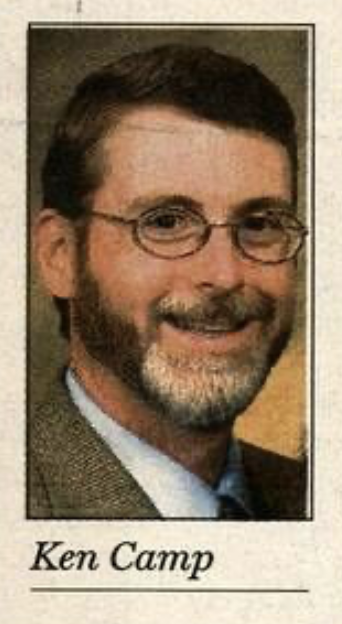
Baptist Standard Managing Editor Ken Camp will retire Dec. 31, 2025, bringing to a close a decades-long era of reporting on Texas Baptists.
Ken Camp, 2015
During the last 40-plus years, Camp has reported on every part of the Baptist General Convention of Texas. He also has covered the Southern Baptist Convention, Cooperative Baptist Fellowship, Baptist World Alliance and other Baptist entities.
“Ken Camp has always been a torchbearer for the truth,” John Hall, chief mission officer for Texans on Mission, said. “He has always believed Christians will respond when they know about opportunities to share the gospel in their own communities, across their state and around the world.
“Over the years, I’ve seen time and again he is correct,” Hall continued, “and many, many people got involved in ministry because of the stories Ken shared clearly, concisely and compassionately. I know. I’m one of them.”
Reporting these stories has taken Camp all around Texas and to several places around the world. He has had a front-row seat to some of the most consequential events in Texas Baptist and Southern Baptist history.
“I’ve been in the same room with four United States presidents or former presidents,” though “some of the rooms were pretty big,” Camp noted.
“But the people who made the deepest impression were folks like a West Texas pastor who visited almost every patient in the local hospital every morning except Sunday for 40 years and a Central Texas pastor who has served the same small, rural congregation for 60 years and counting,” Camp recalled.
Early days in journalism
Camp’s name has appeared in bylines for more than 50 years, first as the editor of his high school newspaper and as the writer of a weekly column about school news for the Greenville Herald Banner. The summer after he graduated, he worked the evening sports desk part time for the local newspaper.
Despite his high school experience in journalism, Camp had other career plans. He began college with a double major in English and history, with plans to go to law school.
“My plans changed after I attended a free lunch at the Baptist Student Union at East Texas State University,” Camp wrote.
“A missions speaker was talking about how Christian vocational service involved more than preaching, and people with specialized skills—including journalism—were needed on the mission field,” he continued.
Though he didn’t feel called to foreign missions, he did have “a clear sense God was calling me to Christian service as a writer. I changed my second major from history to journalism.”
Becoming a Texas Baptist journalist
To prepare for Christian service, Camp attended Southwestern Baptist Theological Seminary. Upon his arrival, he learned Southwestern was launching a communications program. The program required an internship, which he found with the Texas Baptist Public Relations Association, working at the BGCT during the summer of 1983.
When Camp graduated from seminary in 1984, he went to work for Tom Brannon and Orville Scott in the BGCT public relations (communications) office.
At the BGCT, Camp wrote news and feature stories on Texas Baptist Men, Woman’s Missionary Union of Texas, the Christian Life Commission, River Ministry, Church Extension (church starting) and more for 19 and a half years.
“Our primary vehicle for communicating with Texas Baptists was through the Baptist Standard. So, I was in daily contact with Toby Druin,” Camp wrote, referring to the Standard’s managing editor at the time.
“Our office also served as the Dallas Bureau for Baptist Press. That meant I was in contact several times a week with Dan Martin and Marv Knox at BP,” he added. Knox later became editor of the Baptist Standard.
When Orville Scott retired, Camp became the news and information director for the BGCT. In his supervisory role, he worked with Baptist journalists John Hall, Ferrell Foster and Dan Martin. He also was in charge of the newsroom at BGCT annual meetings, which hosted religion reporters from newspapers around Texas.
When Tom Brannon retired, Camp served more than a year as the BGCT’s interim communications director.
Memorable experiences during his BGCT years
Camp described working the newsroom at the 1985 SBC annual meeting in Dallas as his “baptism by fire.” The meeting “drew 45,531 messengers,” he reported.
“Charles Stanley was elected president, defeating Winfred Moore [pastor of First Baptist Church in Amarillo] in a 24,453 to 19,795 vote marked by multiple irregularities. On the row in front of where my wife and I were seated, we saw a couple casting ballots for their children—including an infant,” Camp recalled.
A few months later, in the immediate aftermath of the Mexico City earthquake, Camp traveled there with the initial TBM disaster relief team at the request of the National Baptist Convention of Mexico.
“From the field kitchen set up outdoors in downtown Mexico City—where thousands of people were sheltered in a tent city—the TBM volunteers served about 2,000 meals an hour for the first four hours,” he wrote.
Camp also reported on Partnership Missions in Australia and Mexico, as well as River Ministry along the Texas/Mexico border. When the BGCT launched its Mission Texas initiative to start 2,000 new churches in Texas within five years, Camp made day trips to churches around the state for feature articles about church starting.
Reporting from Oklahoma City at the request of Associated Baptist Press in the days immediately following the bombing of the Murrah Federal Building on April 19, 1995, was a particularly moving experience for Camp.
“I saw a city sustained by their faith in God and by his grace,” Camp stated. “Over the course of several days, I was able to attend a prayer gathering at a local church, interview chaplains who served first responders at the bombsite, interview survivors of the blast, and attend the community-wide prayer service where Billy Graham and President Bill Clinton spoke.”
Working with giants
Of particular note to Camp during his years at the BGCT was “the rare privilege of working with and learning from giants: Phil Strickland and Weston Ware at the Christian Life Commission, Bob Dixon and John LaNoue at Texas Baptist Men, Joy Fenner at Texas WMU, Elmin Howell at River Ministry and many more. I’ve been blessed to tell their stories.”
Referring back to his trip to Mexico City, Camp recalled spending part of the trip there riding in a truck with John LaNoue.
“I remember asking him late at night what his motivation was for all the work he had done—creating the first disaster relief mobile unit and serving as on-site coordinator at disasters far and wide,” Camp recalled.
“He told me Jesus did two things throughout his public ministry—he met human needs where he found them, and he pointed people to God,” Camp continued.
“That’s what disaster relief ministry does, and reporting on God’s work through the volunteers the past four decades has been one of my great joys,” he concluded.
Joining the Baptist Standard
Ken Camp in 2003 when he was named Baptist Standard managing editor. (File photo)
Camp was named managing editor of the Baptist Standard in December 2003, beginning work effective Jan. 1, 2004. He followed Mark Wingfield, who resigned to become associate pastor at Wilshire Baptist Church in Dallas.
The Baptist Building—as the BGCT office building at 333 N. Washington Avenue east of downtown Dallas was known—was a busy place in the 1980s and 1990s, “a constant stream of people in and out of our office,” Camp recalled.
Camp’s move from BGCT communications to the comparatively quiet Baptist Standard office at 2343 Lone Star Drive west of downtown Dallas enabled him “to concentrate on writing and editing, rather than having to attend all the meetings required at the Baptist Building.”
“Serving as managing editor at the Standard had been my dream job since I was in seminary,” Camp said, “and I was eager to have the opportunity to work on a daily basis with Marv Knox, who was a good friend and for whom I always have had the greatest respect.”
“Hiring Ken was one of the best day’s work I put in across almost two decades of editing the Standard,” Knox, retired editor of the Baptist Standard, noted.
“He always helped the Standard maintain its core mission—inform Texas Baptists about the opportunities, challenges, issues and developments that impact their churches, as well as the Baptist General Convention of Texas,” Knox added.
Reporting for the Baptist Standard
During his two decades as reporter and managing editor of the Baptist Standard, Camp had numerous interesting experiences, such as interviewing Texas Death Rowinmates and ex-convicts.
Camp traveled to Ethiopia and Kenya with Buckner International and to Cuba and Uganda with Texas Baptist Men (now Texans on Mission) to report on their work in those countries.
He also reported on Baptist World Alliance Congresses in Birmingham, England; Honolulu, Hawaii; and Brisbane, Australia; and BWA annual meetings in Birmingham, Ala., and Stavanger, Norway.
Camp regularly reported on the work of the Christian Life Commission, “from public advocacy in the Texas Legislature to the support of human-need ministries around the state and the globe through the Texas Baptist Hunger Offering.”
“My greatest delight has been the people with whom I’ve worked and the wonderful folks I have met around the state,” Camp stated.
“It’s people like Jimmy and Janet Dorrell, who have lived among and served the poor in Waco for more than four and a half decades,” Camp recounted. “It’s volunteers who dig water wells, build churches, teach English-as-a-Second-Language classes, minister to children, and stock the shelves of food pantries.”
Challenges in reporting
Working in the BGCT’s public relations office came with some inherent tension.
To overcome the tension, “I leaned hard into the advice that the best public relations is to tell the truth and be as forthcoming as possible,” Camp said.
Having the Baptist Standard as a check also helped, Camp noted, saying if he didn’t report on a matter, the Standard could and probably would report on it.
Presnall Wood (center), who served the Baptist Standard as its most long-tenured editor, died March 10. Editorial leadership of the Baptist Standard spanning more than four decades gathered for a reception to mark the departure of Marv Knox as editor in 2017. They included, from left, Ken Camp, managing editor, 2004-present; Mark Wingfield, managing editor, 1999-2003; Wood, editor, 1977-95; Knox, associate editor, 1995-98; editor, 1999-2017; Toby Druin, associate editor, 1976-1995; editor, 1996-98. (Photo by David Clanton)
At the Standard, reporting the investigation into a church-starting scandal involving phantom churches in the Rio Grande Valley was a particular challenge, Camp recalled.
“Texas Baptists sunk more than $1.3 million into start-up funding and monthly support for three pastors in the Valley who reported 258 church starts between 1999 and 2005,” he reported.
“Investigators said up to 98 percent of those churches no longer existed in 2006, and many of them never did—except on paper,” he added.
“It was not a good time for the BGCT, but it needed to be reported, and we did it,” Camp stated.
Given the BaptistStandard is a denominational news source, the decline of denominational loyalty and “a rapidly shrinking market for honest reporting” presented a continuous challenge during Camp’s tenure with the Standard.
Transitioning from the printed newspaper to an online-only publication was a personal challenge for Camp. In addition to learning new technology, “the news cycle changed drastically,” he noted.
“Instead of producing in-depth, long-form articles for a newspaper printed every other week or human-interest feature stories for a monthly magazine, we’re now providing relatively brief breaking news on a daily basis—actually, multiple times a day,” Camp wrote.
“Providing content for the internet is like trying to feed a ravenous beast always craving more. I won’t miss that part,” he concluded.
Camp as a mentor
Reflecting on his early career working with Camp, John Hall recalled: “I learned to write as a result of Ken’s editing and instruction. He didn’t just edit a piece and hand it back to you to correct. He made the editing marks and then went through each one of them with you. He educated me by walking beside me. He was a mentor in the best sense of the word.”
Camp is more than a reporter and writer, however, Hall noted. “It’s what he did beyond the written word that has most impacted me.
“When I moved to Dallas and knew few people, Ken would stay late, somehow knowing I needed a friend. I saw him get excited about ministry in his church, raising his sons and people coming to faith. In many ways, I didn’t just learn how to be a journalist from Ken. I learned what it truly means to be a Christian.”
“The first assignment Ken gave me when I was 23 was to cover a cutting-edge church in Houston. I remember it vividly,” Hall recalled.
“I was so excited to go on the trip by myself. I was a grown up, and he asked me to write an article and shoot photographs of the service. I was going to nail it.
“I did all the interviews. The quotes were fantastic. … I took photo after photo after photo of a highly visual service. There was so much to shoot, that I just kept shooting.
“I turned in the story shortly after and gave Ken back the camera. That’s when I realized I never put film in the camera. I had no photos, and I was standing before this man I’d read faithfully for years.
“I apologized profusely [and] braced myself for a severe talking to. Instead, Ken took a breath and sighed. Then, he let out a laugh that could only be Ken’s.
“‘Don’t worry,’ he told me. ‘I did it on my first assignment, too. We’ll figure out something.’”
Hall described Camp’s response in two words: “Grace. Kindness.”
“Then,” Hall continued, “Ken quickly followed it up with, ‘But you only do it once.’
“An opportunity to learn and grow. That’s Ken Camp,” Hall concluded.
Baseball and family
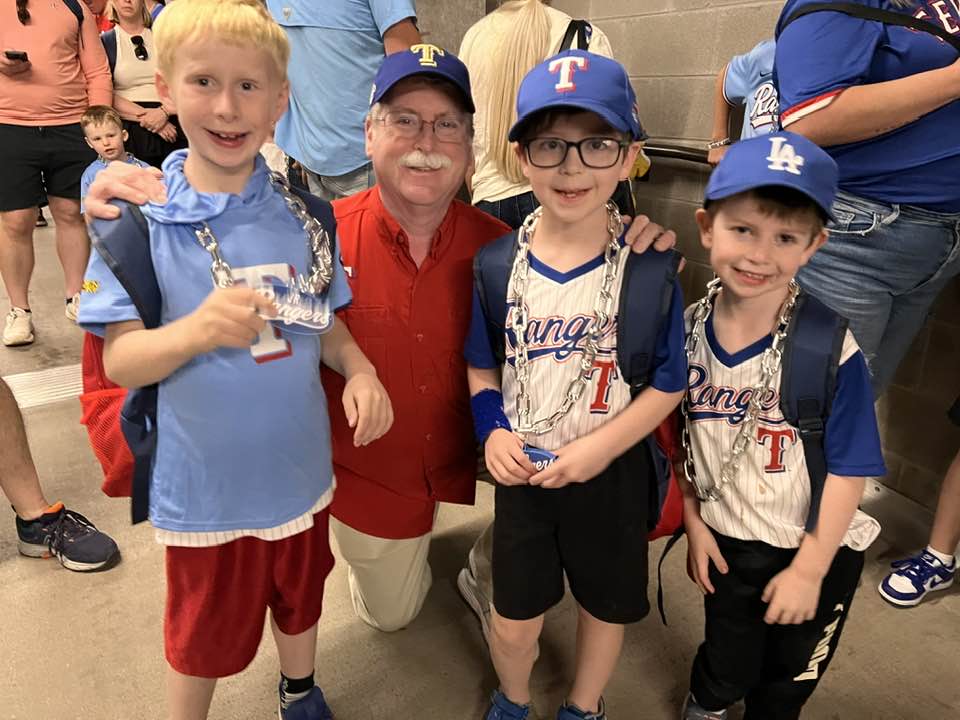
Camp is not shy about his love for his family and for Texas Rangers baseball.
Ken Camp with grandsons at a Texas Rangers baseball game. (Photo used by permission)
“You can’t talk about Ken Camp without mentioning the grandkids and baseball. I’m pretty sure the grandkids come first, but baseball is a close second,” Scott Collins, retired vice president of communications for Buckner International, wrote.
“I remember sitting next to Ken for entire games and saying few words, because Ken was keeping score,” Marv Knox recalled.
“However, he could provide a perfect recitation of the turning points of the game and analysis of how his beloved Rangers were doing in any given year. This not only reflects Ken’s love of baseball, but also his meticulous attention to detail, which made him a splendid reporter,” Knox wrote.
Camp’s colleagues remember him bringing his family to BGCT annual meetings. However, his children remember it best.
“When my brothers and I were little, BGCT annual meeting happened to fall on or around Halloween,” Daniel Camp recalled. “So, Dad and Mom dressed us up in our costumes, and we trick-or-treated through the newsroom.
“Dad said he remembers going around to all the reporters beforehand, giving them all candy, so they’d have something to hand out, and telling them to put out their cigarettes for a minute,” Daniel continued.
Reflecting on a career
As Camp nears retirement, he reflected on his more than four decades reporting on Texas Baptists: “It’s been an honor to have worked for organizations committed to historic Baptist principles—the Lordship of Jesus Christ, biblical authority, soul competency, the priesthood of believers, religious liberty, and the separation of church and state.
“I have loved to tell the stories of how God is at work in and through Texas Baptists. I hope I’ve been able to bear witness faithfully to what the Lord has done and continues to do.
“In recent years, it’s been amazing how many opportunities we’ve had to report on international religious freedom issues, thanks to contacts with the Baptist World Alliance and the 21Wilberforce human rights organization.
“At times, those stories have attracted the attention of government officials—in the United States and in foreign countries. I never dreamed I’d be involved in something like that.”
Expressing his decades-long commitment to accurate, thorough and fair reporting, Camp said: “Texas Baptists need the Baptist Standard. Self-governing organizations like the BGCT need informed constituents to make wise decisions. That requires a credible, honest, independent source of information.”
*******
Family and colleagues describe Ken Camp
Daniel Camp, Ken’s son and pastor, South Garland Baptist Church
Praising Ken’s objectivity and fairness, Daniel said: “He is not an editorial writer and doesn’t try to be. You won’t catch him sneaking his own opinions into his reporting.
“He is there to report on what has happened, providing meaningful context where it’s helpful, but he is not there to convince or persuade. He’s a reporter first.”
Daniel noted Ken’s attention to detail: “I’ve seen him reporting and am always impressed by how fast his pen is moving when facts and figures are being thrown around. He’s not going to miss one.”
Daniel also noted Ken’s eye for a good story: “He knows what kind of stories he wants to read and what our churches need to hear, and he gravitates toward those.”
Toby Druin, editor emeritus, Baptist Standard
“I remember the first time I saw Ken Camp’s byline on a story I received at the BaptistStandard from the BGCT public relations office. It was tight and required little editing—just like the flood of stories Ken has written over the years.
“Ken has been an excellent presenter of the Texas Baptist story. Baptist Standard readers have always been able to depend on him to give them the information they need to be informed [and] to be better Baptist Christians.”
Marv Knox, retired editor, Baptist Standard
“Ken is full of integrity. … He’s also careful and conscientious.
“As a thoughtful, lifelong Texas Baptist, he always has been able to write articles in context, helping readers understand the setting and impact of the events he covered.”
His reporting “always put the Standard in a good light—even, or maybe especially, among people who didn’t particularly care for the Standard’s editorial positions.
“Because he is so disciplined and focused, he enabled the Standard to move easily into the era of digital news coverage. He would finish gathering information and immediately sit down and write an article. We often posted stories about Texas Baptist events before the people involved in those events even got home.”
John Hall, chief mission officer, Texans on Mission
“Watching Ken work is inspiring. He can turn a story in minutes, make any piece worthy of publishing through masterful editing and communicate complex topics in ways everyone can understand.”
“He was fair to everyone and everything he covered. He wanted people to hear all sides of a conversation.”
Scott Collins, retired vice president of communications, Buckner International
“When I think of Ken Camp as a reporter, the first word that comes to mind is ‘thoroughness.’ I’ve always known when I read a story with Ken’s byline that he covered the whole thing. There was no need to ask, ‘What else?’”
Like Daniel Camp, Collins also described Ken as accurate and fair: “Ken has always been driven by his ethics when it comes to reporting. So, I know when I read something he has written, he is reporting with fairness.
“Because of Ken’s experiences in Baptist life over the past four decades, he has provided a perspective for Standardreaders he is uniquely qualified to provide.”
“Ken is … probably the most reliable person in Baptist communications today.”
Cowboy church disciples men
December 15, 2025
In 2011, Montague County Cowboy Church Pastor Joe Caballero took a camping trip with his family, along with two other families, to Carson National Forest in New Mexico.
While camping, they met the man who cares for the cattle grazing in that area.
“The [cattle owners] hire a guy they call a ‘rider’ to stay in the mountains with the cattle all summer, keep an eye out, ride fences and so forth. Well, we were camped right where he was because there’s some horse pens up there [and] we made friends with him,” explained Caballero.
The rider introduced Caballero to the cattle owners Jeff Martinez of Rio Vega Ranch and Jeff Larsen of Don Larsen Land & Cattle Co., both located in Alamosa, Colo.
Caballero learned that Martinez and Larsen “round [the cattle] up in October” when he and a friend were in Alamosa the next weekend to retrieve some misplaced equipment from their camp, and the two volunteered to help “drive [the cattle] out of the mountain.”
Caballero said this “turned into an annual thing.”
“Now I know why Jesus left and always went into the mountains to pray and get re-energized and then come back and start ministering again,” said Caballero.
Over the years of returning to Carson National Forest to help Martinez and Larsen drive cattle, God was laying it on Caballero’s heart that he could involve more men in the experience.
In 2020, he said the Lord “really started pushing” the idea for The Drive, a week of worship, discipleship and driving cattle for Montague County Cowboy Church men.”
“I was thinking, ‘No one’s going to want to do this’ … [but] God just kept on and on, and finally I said: ‘Okay I’ll bring it before the church. We’ll see if anybody’s interested,’ and when I made the announcement about ‘The Drive,’ [there was a great response],” said Caballero.
Caballero said God gave him an analogy for what would be the mission of “The Drive:” to help get men to Jesus “from wherever they are.”
“On the last day [of The Drive], we drive them like 20, 21 miles out of the mountains, all the way down to the shipping pens,” explained Caballero.
“The analogy of it is if we don’t get the cattle out before winter hits, the first snow, they’re going to be snowed in, and the cattle, they’re going to die. Same thing with our men today. Sometimes you don’t even realize you’re in a desolate area, but you need people to come and gather you up and move you to a better place [which] is being with Christ.”
In October 2023, men from Montague County Cowboy Church traveled to Carson National Forest for the inaugural trip of The Drive, which served as a training year for the Wranglers, men who care for the camp and horses, and also serve as ministers to the guests.
Caballero said he was encouraged by the change he saw in the men when they returned from The Drive.
“It set these guys on fire, the ones that were up there for the training. It created a camaraderie of men that now are friends and coming back after that week together, how they acted in church was totally different,” said Caballero.
Discipling while driving cattle
Every Oct. 1-6, 30 men are invited to participate in The Drive, 12 as guests and the rest come to serve as Wranglers, chuckwagon cooks or video crew for the week.
Guests arrive at the camp on the evening of Oct. 1 and are briefed on the week ahead. The next two days, participants will gather for their morning tent meeting, where they will hear a devotional “to reflect on throughout the day” and prepare for the evening tent meeting, which will be a worship service.
Between tent meetings, guests will pair up with a Wrangler and gather cattle into The Beaver, a 12,000-acre pasture where the cattle are contained on the mountain.
Caballero said pairing up guests with Wranglers is intentional for both safety and discipleship.
“Everybody has a partner, that way if something happens, somebody is there to help them. So, we always do two by two, just like Jesus sent his disciples out, we send the guys out two by two,” explained Caballero. “So, these Wranglers have the opportunity to minister to them all day long while they’re gathering cattle.”
After taking an “off day” on the third day, guests “do the big gathering where we go over into The Beaver [and] gather all the cattle that day that are in that pasture, and we put them in this trap. Then the next day, we’ll get up and we’re going to drive them all the way down the mountain.”
The Drive is concluded with “a big church service” to focus on how Caballero and the Wranglers “can help these guys get out of the [spiritual] predicaments that they’re in.”
Caballero said the powerful part of the week is hearing how God moved in the guests’ lives.
“We have a video crew that goes with us, and they interview every guest. The night [guests] get there, [the video crew will] interview and say: ‘What are you here for? What do you expect?’ Those are your two main questions. Then on the last day, they’ll interview [guests] again and say, ‘So, did you get what you were looking for?’ … That’s where the power is,” said Caballero.
Becoming a ‘night-and-day different man’
Dewey Hill’s was a particularly powerful testimony from The Drive for Caballero.
Hill went on the first Drive in 2023 after reconnecting with Caballero and beginning to attend Montague County Cowboy Church.
“I’ve known him since he was a kid [and] I hadn’t seen him in years, and then all of a sudden, Dewey pops up again and [was] living a life that was taking him nowhere … [So] I said, ‘Well, if I get him on this Drive, maybe it’ll grab a hold of him [spiritually],’” explained Caballero.
Caballero said the first year he “just walked around with a cup of coffee in his hand” and didn’t participate. But he decided not to give up on Hill and invited him to attend The Drive again in 2024.
“The second year, [Hill was doing] the same thing, and I told the guys, I said: ‘I’m going to have to [not invite] him [back] because as much money as this costs us, I need guys that are serious and who are going to be all in,” explained Caballero.
Caballero said the next night, Hill returned from taking a call after the tent meeting was over and said, “You’re going to have to preach that sermon again. … I’ve got to know what y’all talked about.”
“I preached that sermon all over again and he surrendered himself right there, gave himself to the Lord [and] got baptized the next day,” said Caballero. “It’s been the most miraculous thing to see the power of God change the men that you think are a hopeless case, but the Lord says, ‘No, I’ve got him.’”
Hill asked Doug White, a chuckwagon cook on The Drive, to baptize him. He said over his two years of attending The Drive, White became a “father figure” to him.
“I don’t think that Doug and I had ever even shaken hands or exchanged conversation at church before we got up [to New Mexico]. But from that year to the following year, we did develop a relationship,” explained Hill. “[He’s had] an amazing impact on my life.”
Hill said since accepting Christ, he’s a “night-and-day different man.”
“I totally said: ‘Here you go. I’m done. I want to live for you … and I’ve never looked back,’” said Hill. “I hope the way I live is evident to those around me.”
Caballero said he witnessed Hill go through a transformation he doesn’t see often.
“[Hill’s] on fire. I’m so excited about him, because I’ve seen him grow up and the lifestyle that he lived, and what he’s doing now, this transformation, I’m telling you, doesn’t happen like this very often,” said Caballero. “He said: ‘The Lord says now. So, I’m in,’ and he has changed everything. It’s just unbelievable.”
Making more men of God
Caballero said, “It’s been a blessing to see the change in the men that have come up here.”
“[God] just keeps sending the right guys every time,” said Caballero. “Most of the guys come from our church, so it’s been a real pleasure seeing them when they come back. Now, they’re involved in church, and they’re getting involved in different parts of the ministries within the church. They’ve got this tight brotherhood now [and] are just having the best time of their life.”
Caballero said he’s looking forward to The Drive 2026 looking a little different.
“So, this year, we’re going to send out to the cowboy churches, and we’re going to try to get the churches that maybe sponsor two guys from each church,” explained Caballero. “I’m hoping it’s going to be a good mission outreach for their men, because we need to get our men back in the game.”
Caballero said he’s excited to get other churches involved in The Drive.
“I’ve seen [men] change, and that’s been the blessing about it. So, what I look forward to is the next change,” said Caballero.
Caballero said cowboys are “tough, set in their ways,” but are looking to stand up for the truth.
“They’re going to tear everything down to make sure that whatever you tell them is the truth,” said Caballero. “Once they get a hold of the truth, the Bible, they’ll fight for it, they’ll stand up.”
“They don’t care what anybody thinks. That’s what I’m looking forward to: making more men of God.”
You can learn more about The Drive and hear stories of life change on YouTube.
Baylor football team Bible study yields baptisms
December 15, 2025
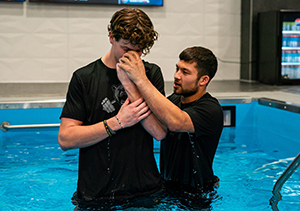
Ten athletes on the Baylor Bears football team publicly expressed their faith commitments to Christ by being baptized in the university athletic facility’s hydrotherapy pool in early November.
Some recently accepted Jesus as Lord and Savior. Others made a past faith commitment to Christ but never had been baptized. Some had been baptized at an early age but wanted to be baptized as believers as a reaffirmation of their faith.
All of the newly baptized believers participate in a Tuesday evening player-led Bible study in the Baylor University football team meeting room.
“We meet at 6:30, share a meal together and then dive into the word [of God], splitting up into small groups,” said safety Michael Allen, one of the small-group leaders who baptized three of his teammates.
Sawyer Robertson, starting quarterback for the Baylor Bears and a small-group Bible study leader, baptizes a teammate. (Baylor Athletics Photo)
Other small-group Bible study leaders are starting quarterback Sawyer Robertson, wide receiver Josh Cameron, outside linebacker Kyler Jordan, safety Jacob Redding, defensive lineman Dylan Shaub, tight end Matthew Klopfenstein and quarterback Walker White.
In addition to the Tuesday evening meetings, some players—particularly new believers—also get together for regular one-to-one discipleship times with their small group leaders and participate in an online group chat, Allen added.
“I’m getting the chance to walk through Proverbs with two of the guys right now,” he said.
At least one-third of players involved in Bible study
Allen and former teammate Garrison Grimes, who later transferred to Brigham Young University, started the Bible study in spring 2024 with about a half-dozen other players.
The group now numbers 35 to 40 on a typical Tuesday evening—at least one-third of the players on the Baylor football team roster.
Landrie Walsh, director of football operations at Baylor, helps secure food for the weekly gatherings, Allen noted.
“One of the biggest ways to incentivize 300-pound linemen is to have food at the Bible study,” he quipped.
The small groups recently completed a character study of Joseph from the book of Genesis, focusing on themes of forgiveness, patience, perspective and leaving a legacy of faith.
While the Bible study is not sponsored by a specific congregation, several players worship together regularly at Harris Creek Baptist Church, and the congregation provided some curriculum initially, Allen noted.
Baptisms mark significant step
“We have baptisms offered at the end of every study every semester,” he said.
Ten athletes on the Baylor Bears football team publicly expressed their faith commitments to Christ by being baptized in the university athletic facility’s hydrotherapy pool in early November. (Baylor Athletics Photo)
Kevin Washington, associate athletics director for mission impact and enrichment at Baylor, presents a devotional about baptism the week before each scheduled baptism, explaining its significance, Allen said.
The 10 most-recent baptisms account for about half of all those performed since the Bible study launched.
Allen maintains contact with some of the players involved in the Bible study who have graduated and moved on to their careers. He specifically noted Treven Ma’ae, now a defensive tackle with the Las Vegas Raiders.
“He got baptized here, and it was kind of his first introduction to Christianity,” Allen said. “I text him every once in a while, just to see how he’s doing. It’s cool to have relationships that are way beyond football. Those are the things that are going to last.”
Bible study creates connections
The ongoing weekly Bible studies have affected the culture of the Baylor Bears football team positively, Allen said.
“I can’t say enough about the small-group discussions,” he said, particularly for players who live in a culture “where everything is judged by how you perform on a football field.”
The Bible study offers players the opportunity “to dive into our faith and understand that whatever happened that past Saturday does not define us as individuals,” Allen said.
Without minimizing the importance of doing their best in competition, players gain perspective and learn football “isn’t the end-all and be-all,” he said.
“We understand that football is going to end at some point, and very soon for a lot of us. So, it’s who are we going to be—as Christ followers, as men, as husbands and fathers. An opportunity to talk about those things in a group that you’re really, really close with fosters a ton of connection among the team.”
Allen particularly noted a deeper personal and spiritual connection between Robertson and a member of his small group—tight end Michael Trigg.
“I’ve seen their relationship flourish and connect on a deeper level,” he said. “They dive into the word [of God] together every Tuesday evening, and then then go out there [on the gridiron] and have a connection on Saturday.”
Honest and vulnerable discussions
The honesty expressed in the small-group discussions has built trust and developed deeper bonds between teammates, he said.
“We’ve had a lot of guys open up in those small groups. It’s a pretty vulnerable space,” Allen said.
Players come from varied backgrounds, and many did not grow up in strong Christian homes, he noted. They freely discuss their upbringing, as well as “sin struggles” common to young men, he added.
“We’ve all had different walks to faith,” Allen said. “For some guys, this may be the first time they’ve heard a real explanation of the gospel.”
Players also “talk a lot about who we want to be—as men and as leaders,” he added.
Helped clarify calling
Allen, who completed his undergraduate degree in finance and is pursuing a Master of Business Administration degree, said taking a leadership role in the team Bible study has helped him find direction beyond school.
Michael Allen, who was instrumental in launching a Tuesday evening Bible study among players on the Baylor Bears football team, baptizes a teammate. (Baylor Athletics Photo)
“I’m probably not going to use my major, to be completely honest. I’m thinking about going into coaching,” he said. “I see an incredible opportunity for building relationships.
“This is a great ministry opportunity, having the ability to mold people, to see the best in somebody and challenge them to be the best they can be.”
In a sense, that’s what the player-led Bible study does—meeting student-athletes where they are in their faith journey and helping them grow spiritually, Allen said.
“Honestly, through this Bible study, I feel like it has helped clarify my calling to coach,” he said. “That’s what coaching is. It’s servant leadership.”